


— by Claire Nagashima
Student, Level 2 Yoga Wellnesss Instructor, Swasti Yoga Center, Pune
Japan is the most convenient place for tourists – I heard some traveller saying that, and I do not object to the statement as a Japanese person myself.
The well facilitated infrastructure, perfectly punctual transportation, bullet trains running across the whole country (over four islands!), ever so clean public toilets and kiosks with food, stationary, mobile battery chargers… a. Robots serving in restaurants, skyscrapers covering the sky, trending international franchises with metres and metres of queue, you can find anything for your convenience if you drop by our capital, Tokyo and surrounding cities.
I guess I was soaked in the convenience too after having lived in Tokyo for a while.
In Japan, we have a character perfectly describing the state of “absent minded” which is.
This character consists of two parts, the left side signifies “heart”, the right side signifies “lost” or “deceased” and the character literally means “busy”.
I felt this a lot when I was in Japan. I was so busy – my mind, my schedule, with everything that occupied me – I was content with whatever duties I was under, work, housework, relationships, social duties… but I also knew at the same time – I was chronically in the state of.

There are plastic products, quick and easy snacks with artificial additives, extremely convenient machines and robots flooding today, not only in Japan but everywhere. We are so used to having our desires fulfilled that we want more as we are supplied, we seek more convenience, more comfort, and in consequence, we are losing the connection with nature and to a certain extent, with “self” in those environments.
Recently, before coming to India, I lived in Europe. Living in Europe was one of the eye opening experiences for me. The consciousness toward the protection of the environment, the progressive mindset toward environmental sustainability-
Living with minimal things, enjoying nature, the “why drive a car when you have buses” mindset. I could fully enjoy what I was given and I started seeking no more than I already had. I started riding bicycles and started drinking tap water rather than buying water bottles, started recycling more, I enjoyed the world with less things, and less wastes.

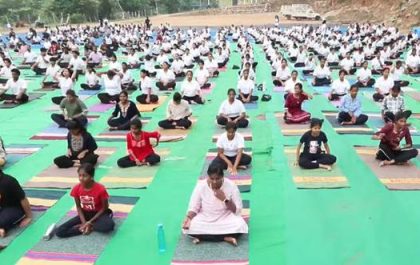
And now, I am in India, to pursue the study of Yoga.
I came here with very little knowledge about Indian philosophy, and I did not know how Indian people managed their lives in India.
When you view India from outside – you can have whatever stereotype you want to have.
“IT people”, “Military strength”, “Huge population”, “Bollywood dance”, “Uncountable languages”… some of which can just be my stereotypes but, even after having had several friends from India, I could not tell what India was like from outside. All I was sure about was that it was not only about Taj Mahal and the beautiful scenery.
India, as the country celebrated its 75th independence recently, is definitely not the oldest country remaining in the same geographical shape for the entire duration. But when you delve into what India is about since ancient times, you can spend your lifetime reading and studying about it and will never get bored or tired from it.
On the day of the arrival, I was served a copper glass of water.
I was surprised about two things. Why water? And why copper?
Any country has their own custom, but that was one of the most surprising ones.
I was later told that 97% of the bacteria in the water can be killed if the water is left in a copper container overnight, so that they use copper for making their “drinking water”.
Even in so-we-call “developed countries”, we buy bottled water, for the virtue of convenience or for the “flavour”. In ”developing country” of course, we buy bottled water or boil it every time before consuming.
In Europe, I was told that if you leave tap water for a few hours in a fridge, the smell (of the chemical) will go away so you can drink decent water without buying bottles, and that was a good, eco-friendly tip already but, India’s custom totally had me in awe.
I have not experienced enough of authentic Indian lifestyle to tell so much of Ayurvedic science and lifestyle but, reading about Ayurveda, and experiencing such little things make me feel like there are so much more we can learn from Indian science, customs and traditions and apply to our daily lives now and in the future for the pursuit of sustainable living. Earthen pots in summer for storing water and eating from Thali metal plates, there is just so much more to see.
India knows how to enjoy one’s life, and at the same time cherishes everything around them. Nature, the animals, irrespective of the differences as species. Hope in the near future, we can accept and appreciate the differences of the culture between countries and regions and, exchange ideas, incorporate what’s best for each of us and pursue the best for all of us, and to the world as a whole.
I am grateful to say, I look forward to experiencing, and learning more of India.