


Prof. (Dr.) Mritunjay Rathore
AII India Institute of Medical science, Raipur (C.G)
Secretary, Indian yoga association, CG Chapter
Knee hyperextension, defined as the extension of the knee joint beyond 180°, is often discouraged in yoga due to concerns regarding ligament strain and joint instability. However, research suggests that mild hyperextension (5°–7°) is a normal anatomical variation rather than a dysfunction (De Carlo & Sell, 1997). Nearly 99% of women and 95% of men naturally exhibit hyperextension, with an average range of 5.5°–6.7° (De Carlo & Sell, 1997). This adaptation allows for energy-efficient posture and reduced muscular effort in standing and walking, distinguishing human locomotion from that of primates, who maintain bent knees for stability (Lieberman, 2013). The primary concern is not whether hyperextension occurs but rather its degree and the ability to stabilize the joint actively. Excessive hyperextension (>10°), previous knee injuries, or ligament laxity may require mindful modifications, but for most individuals, mild hyperextension does not need to be overcorrected (Ramesh et al., 2005).
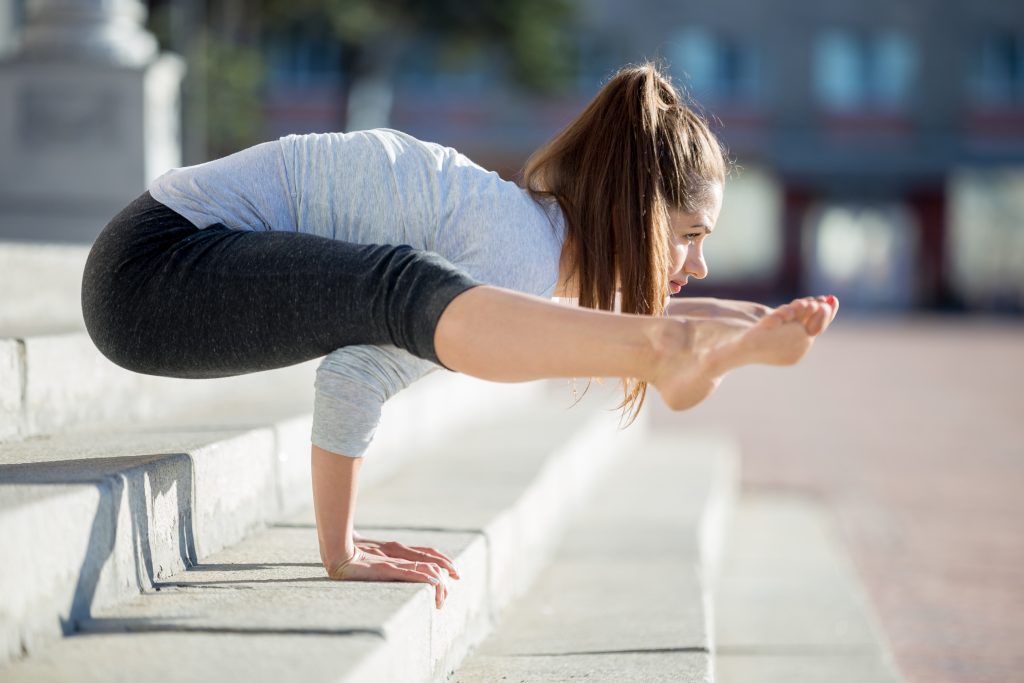
Standing postures such as Natarajasana (Dancer’s Pose), Trikonasana (Triangle Pose), Vrksasana (Tree Pose), and Ardha Chandrasana (Half Moon Pose) commonly involve knee hyperextension in the supporting leg. Unlike dynamic hyperextension, which occurs in high-impact sports and increases the risk of anterior cruciate ligament (ACL) injuries, static hyperextension in yoga poses does not inherently cause damage (Shimokochi & Shultz, 2008). The stress placed on the knee in static postures is significantly lower than the ACL’s tolerance, making concerns over mild hyperextension largely unfounded (Markolf et al., 1990). Even B.K.S. Iyengar naturally hyperextended his knees within the normal range (5°–7°) in various standing poses, emphasizing that this is a biomechanically natural occurrence rather than a flaw to be corrected (Iyengar, 1966). Instead of universally discouraging hyperextension, assessing individual knee alignment and muscle engagement is a more effective approach. Co-contraction techniques—engaging both the quadriceps and hamstrings—can provide active knee support while maintaining optimal movement patterns (Morgan et al., 2010).
A balanced approach to knee hyperextension in yoga practice honors individual anatomical variation rather than imposing rigid alignment rules. Strengthening the hamstrings, calves, and proprioceptive control enhances knee stability for those with excessive hyperextension, while unnecessary corrections—such as habitual micro-bending—may disrupt natural joint mechanics and restrict functional movement (Woo et al., 1991). Instead of a universal avoidance of hyperextension, an awareness-based approach encourages practitioners to develop strength and stability according to their unique body mechanics. For those with significant hyperextension (>10°) or past knee injuries, mindful modifications may be beneficial, but for most, allowing natural hyperextension supports functional movement and postural efficiency (Shelbourne & Trumper, 1997). Understanding the role of hyperextension in human biomechanics fosters a safer, more personalized approach to yoga practice.
References
De Carlo, M. S., & Sell, K. E. (1997). Normative Data for Range of Motion and Single Leg Hop in High School Athletes. Journal of Sports Rehabilitation, 6(3), 246-255.
Lieberman, D. E. (2013). The Story of the Human Body: Evolution, Health, and Disease. Pantheon Books.
Markolf, K. L., Gorek, J. F., Kabo, J. M., & Shapiro, M. S. (1990). Direct Measurement of Resultant Forces in the Anterior Cruciate Ligament: An In Vitro Study Performed with a New Experimental Technique. Journal of Bone and Joint Surgery, 72(4), 557-567.
Morgan, P. M., et al. (2010). The Role of the Oblique Popliteal Ligament and Other Structures in Preventing Knee Hyperextension. American Journal of Sports Medicine, 38(3), 550-557.
Ramesh, R., et al. (2005). The Risk of Anterior Cruciate Ligament Rupture with Generalized Joint Laxity. Journal of Bone and Joint Surgery, 87(2), 800-803.
Shelbourne, K. D., & Trumper, R. V. (1997). Preventing Anterior Knee Pain Following ACL Reconstruction. American Journal of Sports Medicine, 25, 41-47.
Shimokochi, Y., & Shultz, S. J. (2008). Mechanism of Noncontact Anterior Cruciate Ligament Injury. Journal of Athletic Training, 43(4), 396-408.
Woo, S. L., Hollis, J. M., Adams, D. J., Lyon, R. M., & Takai, S. (1991). Tensile Properties of the Human Femur-Anterior Cruciate Ligament-Tibia Complex: The Effects of Specimen Age and Orientation. American Journal of Sports Medicine, 19(3), 217-225.