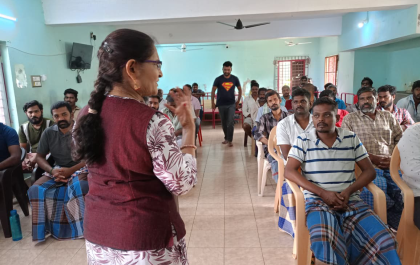
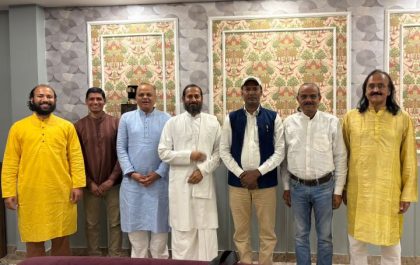
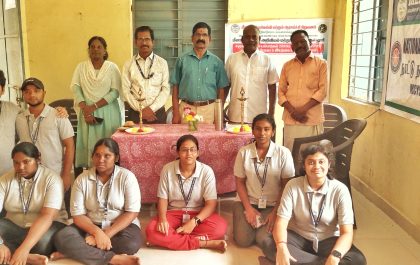
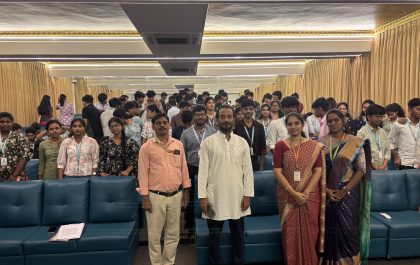
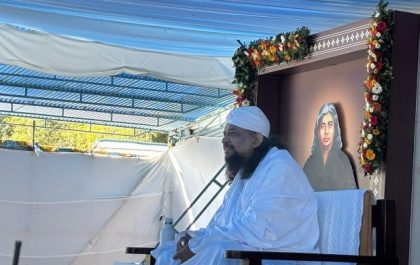


Prajnana Mission, part of the Kriya Yoga International Organization, was established by Paramahamsa Hariharanandaji in 1993 for the propagation of Kriya Yoga
Kriya Yoga
Lineage of Masters
Although the lineage starts from God, this lineage belongs to ‘Kriya Yoga’ that has both sannyasis and householders as gurus.
Since the Vedic age, India’s rich spiritual tradition gives to the world various thoughts of philosophy and spiritualism in the form of nyaya, vaisheshika, sankhya, yoga, purva mimamsa and Vedanta. In this way, Indian spiritualism has evolved richly, starting from Vyasadeva, Patanjali, Vasishta, Gargi, and Shankara, to Swami Vivekananda, Ramana Maharishi and other today’s spiritual giants. All these personalities practiced yoga as a tool for liberation from suffering.
Yoga is defined as
अप्राप्तस्य प्राप्ति स्वीकार योगः
aprāptasya prāpti svīkāra yogaḥ
This means yoga helps to achieve something that one did not have before. Yoga Sutras of Patanjali, a collection of sutras on theory and practice of yoga, mentions about Kriya Yoga.
Kriya Yoga is an intermingling of mythology, history, and science that dates from the dawn of human consciousness. Saints and sages have long practiced this technique and it got lost in the increasing spiritual decline of later epochs. It was revived by Mahavatar Babaji in 1861.
Who is Babaji? A mystifying question! Common minds are interested in knowing antecedents; but great personalities like Babaji stay out of the public eye. Babaji instructs whomsoever he visits confidentiality. Babaji is more interested in influencing mankind’s spiritual evolution by helping the saints and sages carry out their missions on earth.
Babaji’s purpose is to keep pure, original yoga alive in the world. This is the same yoga that is described in Yoga Sutra of Sage Patanjali as
तपः स्वाध्याय ईश्वर प्रन्निधानानि क्रिया योग
tapaḥ svādhyāya īśvara prannidhānāni kriyā yogaḥ
As it was lost due to spiritual ignorance, Babaji reintroduced Kriya Yoga for mankind’s spiritual evolution by sending one of his advanced disciples back to the world in 1828.
Lahiri Mahasaya (1828-1895) is considered to be the first Kriya Yoga guru in modern times. Babaji’s ordain to Lahiri Mahasaya was to teach a simple path of Self-realization for householders and sannyasis.
The meeting of Babaji with Lahiri Mahasaya in 1861 heralded the beginning of a new era of spirituality. While in Benares, Lahiri Mahasaya was inexplicably transferred to Ranikhet. While walking in the mountains, he heard a voice in the distance calling him by name. He proceeded toward the source of the sound and came upon Babaji. Babaji asked, “Do you recognize me?” Though he looked familiar, he could not recognize Babaji properly. When Babaji touched Lahiri Mahasaya on the head, he instantly remembered that he was standing in front of his guru. Babaji then revealed that the purpose of his life was to be a model to all householders and monks alike, and initiated him into Kriya Yoga.
A testimony of Lahiri Mahasaya’s greatness as a Kriya Yogi is the utmost regard that Trailinga Swami, a naked renunciant believed to be an incarnate of Lord Shiva, had for Lahiri Mahasaya. He told of Lahiri Mahasaya as, “What I and other saints have achieved by renouncing the world and even the loincloth, he has achieved while still remaining a householder.”
Lahiri Mahasaya’s foremost disciples are Swami Shriyukteshwarji and Sanyal Mahasaya.
Swami Shriyukteshwarji (1855-1936) got initiated into Kriya Yoga in 1883. Upon the instruction of Mahavatar Babaji in 1894, he wrote ‘Kaivalya Darshan’ uniting the philosophies and metaphysics of East and West. This book was later translated into English as ‘The Holy Science’. He established Karar Ashram in 1903 for the scriptural study and propagation of Kriya Yoga.
Sanyal Mahasaya (1877-1962) is a realized householder who achieved the supreme state of samadhi between the age of 18 and 19. His worldly life revolved around being a schoolteacher, and he was instrumental in establishing Shantiniketan along with Rabindranath Tagore in 1913.
Paramahamsa Yoganandaji (1893-1952), a disciple of Swami Shriyukteshwarji, is well-known for his book, ‘Autobiography of a Yogi’. This book is the best known ambassador of yoga in the modern world, introducing countless souls to the spiritual path. A great yogi; he often told his disciples, “I do not wish to die in bed, but with my boots on, speaking of God and India.” True to his words, he consciously left the body while addressing an audience in Los Angeles, USA.
Swami Satyanandaji (1896-1971), a childhood friend of Paramahamsa Yoganandaji, met his guru Swami Shriyukteshwarji through Yoganandaji.
Shri Gurudev Paramahamsa Hariharanandaji (1907-2002) lived a life of love, service, and teaching, fulfilling his mission to spread Kriya Yoga. Attaining the state of samadhi at will was the hallmark of his sadhana. Swami Shivananda of Divine Life Society, Rishikesh, expressed his hearty appreciation for his effortless practice of samadhi.
Shri Guruji Paramahamsa Prajnananandaji is the current spiritual master. The timeless bond that exists between guru and disciple is never severed; so is between Shri Gurudev and Shri Guruji. Born in 1959, at a very young age of 39, his master conferred upon him the highest title of Paramahamsa.
The Science of Kriya Yoga
What is Kriya Yoga?
The Sanskrit root of Kriya is kri, to do, to act and react; the same root is found in ‘karma’, the natural principle of cause and effect. Any action or rite is done because of the power of the indwelling soul, ya. Kriya Yoga is thus “union (yoga) with the infinite through a certain action or rite.”
While initiating Lahiri Mahasaya into Kriya Yoga in 1861, Mahavatar Babaji said, “The Kriya Yoga which I am giving to the world through you in this nineteenth century is a revival of the same science which Krishna gave, millenniums ago, and which was later known to Patanjali, Arjuna, Shankara, and others.”
In Indian mythology, even Shri Rama and Shri Krishna practiced Kriya meditation technique. References of Kriya practice are present in the Upanishads, Yoga Vasishtha, and Patanjali Yoga Sutras.
The Benefits of Practicing Kriya Yoga
Each human being in whatever state (physical, mental, and spiritual) one is in, likes to evolve continuously. Swami Shriyukteshwarji said, “Kriya Yoga is an instrument through which human evolution can be quickened.”
When one lives in a house with dirty windows, one cannot clearly see the world. One has to clean the windows inside and outside for a clear vision. Similarly, the senses are like windows through which the mind acts. Every human being accomplishes any task using the mind and senses. But most of the time one complains that he or she is not so successful in performing the task as it is meant to be. A student may lack concentration while studying; a businessman may lack proper judgment in investing; a homemaker may complain of too many works to juggle with; and so on. In every walk of life one faces challenges and aspires to improve.
The practice of Kriya Yoga helps to increase concentration to do any activity by controlling the extroverted state of mind, gives balanced state of mind, helps to manage time properly, and thereby makes life productive and fruitful.
It needs twelve years of normal healthful living to effect even a slight perceptible change in brain structure. But the special meditation and concentration techniques of Kriya Yoga help to circumvent this twelve-year cycle. In short, Kriya Yoga is a simple, psychophysiological method that brings simultaneous development of the body, mind, and intellect.
Physical plane: it gives good health and physical efficiency
Mental plane: it gives concentration, peace, and balanced mind
Spiritual plane: one can be free from karma or the universal chain of causation
Who can learn Kriya Yoga?
It is not out of place to talk about Herb Jeffries’ (1913-2013) experience and conversation with Paramahamsa Yoganandaji about learning Kriya Yoga. Herb Jeffries, an American actor of film and television, was reading ‘The Autobiography of a Yogi’ while convalescing after a small airplane crash. While reading, he recognized that he was protected by a guardian angel during the crash and decided to humble himself before the Master. While talking to Yoganandaji, Herb expressed to him his promiscuous way of living and not following the religious ‘Thou Shall Not’ way of life. He wanted to know from Yoganandaji the ‘What Cans’t Thou?’ He was of the opinion that for learning Kriya Yoga there are some pre-conditions in the way of living. So Yoganandaji asked him, “Do you smoke? Do you drink alcohol? Do you enjoy promiscuously?” After receiving a positive answer from all these questions, Yoganandaji said, “You may continue doing all these things while practicing Kriya Yoga. But I will not guarantee that the desire to do these things will not fall away from you.”
This shows that Kriya Yoga can be learnt by any person who is in any kind of mental and physical disposition. Anybody who has the desire to be calm and peaceful can learn Kriya Yoga. It does not require one to leave anything; no need to change one’s tradition or religion; or one’s own Guru to learn the technique.
How to learn Kriya Yoga?
An Unbroken Line of Direct Transmission
One must receive initiation into the authentic Kriya Yoga directly from the present Guru Paramahamsa Prajnanananda or one of his authorized yogacharyas. As it is a guru-mukhi vidya, there are no correspondence courses or lessons offered online to learn Kriya Yoga.
The sacred initiation process involves the tradition of infusing divine energy for the purification of the seven chakras, senses, and body. The initiation process frees one from burden of fruits of past actions.
How to Get Started
Information can be obtained by mailing office@prajnanamission.org or visiting www.kriya.org / www.prajnanamission.org.
Organization Structure
The organization structure consists of Prajnana Mission (for Asia); Kriya Yoga Institute (for the Americas, Australia, and New Zealand); and Kriya Yoga Center (for Europe and Africa).
The spiritual hierarchy consists of the spiritual head, Shri Guruji Paramahamsa Prajnananandaji, and under Him are the Acharyas and Updhyayas (both monastic and householders).
Activities
Paramahamsa Hariharananda lived by the maxim: “Feed the hungry, teach the students, nurse the sick, and give solace to the distressed.”
Inspired by Shri Gurudev, the Mission is working for the welfare of the whole world.
The major objectives of the Mission are:
● Propagating Kriya Yoga through programs, classes, workshops, and by publishing spiritual literature.
● Activities to provide philanthropic servicethrough charitable health care for the poor and needy, education for the children of the distressed section of society, and disaster relief activities.