



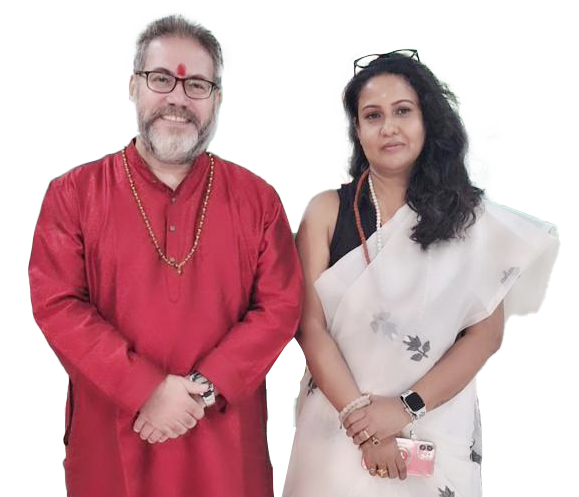
Yogacharini Anandhi Mary Cecil & Yogacharya Dr Ananda Balayogi Bhavanani
Introduction:
The ancient Indian tradition upholds a profound cycle of Srishti, Sthiti and Laya: creation, preservation, and dissolution. This governs both the microcosm of the individual and the macrocosm of the universe, reflecting a unified order across all scales of existence.
yat pinde tat brahmande (Yajurveda II:28)
In this process the “Self” emerges from the unmanifest pure consciousness, thriving in the embrace of time (Kala) through Nama and Roopa; and finally dissolves back into the infinite void at the end of the experience. This is well brought out in the Yoga Darshana of Maharishi Patanjali where he states that the very purpose of the connectivity between pure consciousness and the manifest is for the sake of experience (Bhoga) and liberation (Apavarga).
bhogapavargartham drysyam (Patanjala Yogasutrani II: 18)
“Life” as experienced by the manifest individual (Jeeva), begins as a tiny speck, the zygote in our maternal womb; that then grows through childhood (Brahmacharya), adulthood (Grihastha) and old age (Vanaprasta), only to finally return to nature (potential liberation) in complete renunciation after Sanyasa.
Simultaneously within this cycle of life, new beginnings emerge – through procreation and life perpetuates itself in line with the concept of Maharishi Patanjali who states that nature abhors a vacuum and is always striving for wholesomeness.
jatyantaraparinamah prakrtyapurat (PYS IV:2)
A seed is planted, sprouts with life, blooms with joy and withers with age; yet in doing so gives rise to new seeds that will in turn ensure the continuity of existence. This is how life is constantly echoing nature’s eternal rhythm of Srishti-Sthiti-Laya.
This instinct for self-preservation and the survival of progeny is universal. Animals and birds tirelessly nurture and protect their young, often risking their own lives to ensure the next generation thrives. This grand cycle of existence, seemingly infinite, reveals an intricate natural order: interwoven cycles operating in perfect synchrony. Though complex, this system appears exquisitely designed, functioning with flawless precision.
The Yogic art and science of Yantra:
This natural rhythm is beautifully illustrated in the Yantric System, which serves as a symbolic and energetic representation of these cosmic principles. This is part of the Rishiculture Gitananda Yoga tradition as codified by Yogamaharishi Dr Swami Gitananda Giri Guru Maharaj. He based it on the sacred teachings received by him from his illustrious Guru Yogamaharishi Swami Kanakananda Bhrigu who was part of the living tradition (Guru Parampara) that traces its lineage and heritage back to the great Rishi Bhrigu himself.
In this system, the combination of the month, day and year we are born gives us a clue to our life purpose; and the path we are to walk in this lifetime (Dharma Marga). It also enables us to understand through numerical clues, the hidden and subtle connectivity of time and space that manifest our past-present and future experiences (Karma Yuga).
The nine phases of time are cyclical (1 to 9) and the first three phases (1 to 3) correspond to Sristhi, signifying the genesis of existence, the dynamic impulse of manifestation and the primordial unfolding of the cosmic order.
Seed planting time (The start of a new cycle).
The germination or sprouting period (Nurturing through association).
The period of manifestation and expression (Tender shoots emerge).
The middle three phases (4 to 6) correspond to Sthiti, symbolizing balance, stability and sustenance. This stage represents the maintenance of cosmic harmony, where energy is regulated, order is upheld and existence continues in equilibrium.
The testing period (Plant braves the elements).
The period of rapid growth and change (Emergence of new branches and leaves).
The budding, procreating and decision making period (Buds appear).
The final three phases (7 to 9) correspond to Laya, signifying the gradual withdrawal, transformation and eventual absorption of all manifest forms back into the primordial essence. This stage represents the cyclic return to the formless state, preparing the ground for renewal and rebirth.
Period of blossoming and rest from labour (Flowering).
Time of fruition and reward for labour (Fruits appear and ripen).
The harvest (Pods open dropping seeds).
Unravelling the cyclic rhythm of the Universe:
Another profound concept delineated in the ancient Indian tradition is Rtam–Satyam, representing the fundamental truth and cosmic order that underlies and sustains the universe. Nature reveals a striking truth: patterns repeat in an endless, rhythmic cycle much like a well-tuned cosmic symphony. The sun rises and sets, day follows night, the moon waxes and wanes, tides ebb and flow; and seasons transition from spring’s abundance to winter’s stillness and back again. Celestial bodies move in precise harmony, creating cycles within cycles, days within fortnights, months within seasons, years within cosmic epochs; all woven into the grand design of existence.
We naturally align our lives with nature’s cycles: our sleep-wake rhythm, seasonal routines and daily habits all reflect this harmony. Animals nest, breed and hibernate in tune with their surroundings; while plants sprout, bloom and shed in sync with the seasons. Water evaporates, rains replenish the earth, rivers rise and recede, and soil shifts between moisture and dryness; all in perfect synchrony with nature’s rhythm.
In the science of Yoga, the beautifully orchestrated natural world is known as Prakrti. The inherent order that sustains and governs everything is known as Rita. The very concept of Ritu (seasons), which embodies cyclical rhythms, is believed to originate from Rita.
Alongside Rita, Vedic literature frequently mentions Satyam. The Rig-Veda describes Ritam-Satyam as the first expression of creation: emerging from an unmanifest state of darkness. From primordial waters arose the yearly cycle, followed by night and day, the Sun and Moon, Heaven and Earth. This hymn illustrates that creation which is essentially a beautifully interwoven system of cycles, both in time and space.
rtam ca satyam cabhiddhatapasodya jayata
tatah ratryajayata tatah samudro arnavah
samudradarnavadadhi samvatsaro ajayat
ahoratrani vidadhat visvasya misato vasih
surya candramasau dhata yatha purvamakalpayat
divam ca prthvim, cantariksamatho svah (Rigveda 10.190.1-3)
While Rita represents the latent natural order, akin to the hidden potential of a tree within a seed, Satyam is its tangible realization, as seen in the seed’s sprouting. Just as witnessing a seed grow into a tree helps us to grasp its innate potential, Satyam makes Rita more comprehensible. If Rta is the unseen vitality, Satyam is its manifest reality. This is similar to Purusha & Prakriti or Shiva & Shakti in the various iconic living socio-cultural traditions of Bharatvarsha.
This principle extends to human cognition and communication. When the mind perceives the world in alignment with reality, it is Rita: a true understanding. When speech faithfully conveys this reality without distortion, it is Satyam. Thus, Ritam-Satyam ensures the continuity of true knowledge and transcendental wisdom, just as it orchestrates the cyclical harmony of both the physical and sentient worlds. Ritam-Satyam sustains nature’s cycles, creating the illusion of eternity through infinite repetition.
rit-gum satyam param-brahma puruśam kriśna- pingalam,
urdhvaretam virupakśam viśvaroopay vai namo namah (Narayana Sooktam)
In his Yoga Darshana, Maharishi Patanjali states that we develop a great sense of discernment and understanding of this existential reality through the deep contemplative awareness (Samyama) on the individual moments that make up the sequence of time.
ksanatatkramayoh samyamadvivekajam jnanam (PYS3:53)
In modern times, this is similar to the individual slides (kshana) that make up the continuous video (krama) on our handheld devices. Just like we can pause the video and explore each of the slides, in Samyama we pause time and explore the individual moments to understand the flow of reality. Sporting broadcasters use the ultra-slow motion cameras to a great extent in this regard without knowing that they are performing Samyama.
The Dharma and Karma-Yuga cycles within the Yantric System are but reflections of the deeper rhythm of this Ritam-Satyam – the cosmic order and universal reality. They are not meant for merely delighting in the overtone-undertone combinations that bring pleasure, nor for shrinking away from those that evoke fear and trepidation. Rather, they call for a heightened awareness of life’s ebbs and flows, an intuitive atonement. Like a seasoned sailor who reads the winds and tides, one must learn to navigate the vast ocean of existence with foresight, balance and inner clarity.
Conclusion:
When we apply the philosophy, technology and methodology of Yoga and the Yantric Systems in our inner refinement, we begin to decode the subtle architecture of our karmic patterns. These ancient sciences serve as precise instruments, not just for physical or mental well-being, but for deep self-inquiry and realignment. Through them, we cultivate clarity, resilience and intuitive wisdom; enabling us to navigate life’s complexities with grace, balance and a sense of inner mastery.
The Yantric System transcends the ordinary demands of daily existence; it is not merely a tool for survival or comfort. Rather, it is a multidimensional path of refinement – sharpening the body, mind and subtle energies – to bring the seeker into alignment with the deeper currents of existence. Its ultimate aim is to prepare us for the true purpose of human birth: Self-realisation, the direct experience of the Self beyond name, form and fleeting identities.
Epilogue:
In my journey of Yoga, guided by the loving wisdom of my revered Guru, Dr. Ananda Balayogi Bhavanani, I have been blessed to explore the deeper dimensions of the Rishiculture Gitananda Yoga tradition as codified by Yogamaharishi Dr. Swami Gitananda Giri Guru Maharaj. Our recent immersion into the sacred science of Yantra has opened new pathways of reflection, connecting Yogic wisdom with the profound cultural fabric of Bharatvarsha. As a master trainer in the Indian Knowledge Systems, trained under the aegis of the UGC, this quest, both personal and scholarly, has become a search for inner clarity and rooted understanding. With deep gratitude and reverence, I have woven these reflections together, inspired and guided by my dearest Guruji, Dr. Anandaji.
Bibliography:
Bhavanani AB. Understanding the Yoga Darshan. Dhivyananda Creations, Pondicherry. 2011
Bhavanani AB. Understanding Yantra: A Meditative Contemplative Exploration. http://icyer.com/documents/yantra-abb-2013.pdf
Bhavanani AB. Yoga 1 to 10. Dhivyananda Creations, Pondicherry. 2005.
Gitananda Giri Swami. Yantra. Satya Press, Pondicherry. 1995
Narayana Sooktam. https://premaarpan.wordpress.com/2011/11/15/narayana-suktam/
Strogatz, S.H., 2012. Sync: How order emerges from chaos in the universe, nature, and daily life. Hachette UK.