
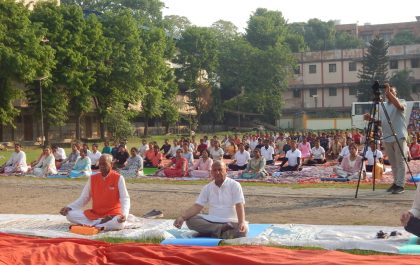




Cultural Appropriation’’ or “Cultural Misappropriation” in the field of Modern Yoga is a topic that keeps coming up and many write to me about it. When my Guru-Father came to Pondicherry in the late 1960s, he settled permanently, founding the Ananda Ashram initially in town, then at Lawspet and finally, at the Sri Kambaliswamy Madam. Ammaji joined him and this marvellous team started an amazing journey for countless students from all over the world who joined our yoga family. Growing up in the ashram, I had a lot of exposure to westerners from different parts of the world who stayed to study with my parents for six months, one year and some stayed two years. I saw students who had become teachers taking yoga back to their parts of the world. They used to write back to Swamiji, to Ammaji and now to me as the present lineage holder and Ashram Acarya.
Swamiji and Ammaji have talked about it. Now I am talking about it. Over the past five decades, the main common thread was the struggle to share yoga in its wholistic, cultural context in other parts of the world where this cultural context doesn’t exist or is seen as suspect and primitive. When trained, students go home and want to know how to replicate and bring traditional yoga alive in their environment. Without exception, everybody struggles. They go back where value may not be put on what is valued here. And value may be put on what is not valued here. Students want to keep what they have learnt in the ashram alive when teaching in their own country but the culture and lifestyle is not the same.
Culture means a living tradition of a society developed so it can grow– culturing. With gardens it’s horticulture. With crops, it’s agriculture. Working with worms, it’s sericulture. In microbiology we do cultures of your blood, semen, urine, or stools to see what microorganisms are growing. Culture means to grow. Every culture, especially ancient culture, has amazing teachings. Asia, India, South America, South Africa, I respect them greatly. India is a living culture. It confuses many Indologists who would like to put India in a box in a museum and study it. There is a living culture which is constantly evolving, transforming, and yoga is an integral part of this. You won’t see that if you go to five star hotels. People come to India, stay in hotels where they have a “keep fit” gym, have a smart yoga instructor teach a few asanas in the morning and afternoon and spend the rest of the day sightseeing at the Taj Mahal, Qutub Minar and enjoy Mussoorie. When you take yoga out of the culture, you have the body but not the soul.
Cultural misappropriation is when people wear Indian clothes as a trend, to fit into the yoga scene, or wear a whole set of Rudraksha malas and embellishments like a fancy dress party just to look cool. These are not worn as ornaments in India. Rudraksha and other malas have special meanings, and are used for specific types of practices or effects, are worn or not worn, kept covered and hidden, or allowed to be visible, for different purposes. When something so very sacred, a symbol of renunciation is taken and misappropriated to serve your temporary fancy trend, you have just killed the whole spirit. Wearing a Rudraksha is a great responsibility, something you need to live up to in thought, word and deed.
On the other hand, there is cultural appreciation, adoration, love, and respect. A majority of our western students sincerely adore Indian culture and get deep into it. When a westerner loves Indian culture, they realise wearing a sari is an art. Many of our students have mastered it well. They love wearing saris because it feels good. They connect to the Universal Divine Feminine power through it. They are not doing it for Instagram followers.
Taking the teachings without credit to the source is also cultural misappropriation. In an academic research paper, find out who has done what, collect this information and then write different statements of people who have worked before, put it together and cite them. In the references or bibliography their paper or the book or the chapter is appropriately cited and the context in which their work is used is given. This is academic integrity. Taking somebody’s published work and pretending it is one’s own without mentioning or citing the name or the reference is academic dishonesty and intellectual property theft. Same thing with the culture.
Appropriate means everything is as it should be. When you have respect for the culture, when you use the cultural symbols or cultural context and you give proper reference, you are respecting it, you are quoting it, you are appreciating it and you are using it as it is meant to be used. Then the term is culturally appropriate yoga. Culturally appropriate yoga is what we need. We need to understand it, not take something and then say this is mine and package it. That is the digestion of yoga. Many people take practices, repackage it, and there’s no reference to the source at all or there’s a trademark, a copyright on it.
Many people in the west think that just because they are Indian, or Indian origin, that they can do anything they want and it will be culturally appropriate. Indian five star hotels are doing cultural misappropriation by the way they misuse our sacred symbols. So, what is happening is there is a lot of misrepresentation and misappropriation. That has to be fought. That has to be pointed out. That has to be brought to the front. And that has to be worked on because it is wrong. It is wrong to take this thousands of years old culture, and just try to sell it as though you are the first one who has invented it. You are not the first one and you will not be the last one also. Because this is timeless, Santana Dharma is timeless.
Just because somebody is white doesn’t mean cultural misappropriation of yoga. We have to be very careful because there are huge smear campaigns against legitimate people who love the culture. There are people who love the culture, who adore the culture, who follow the culture, who live yoga. It boils down to that age-old duality — us versus them. This is not a black versus white, or white versus brown or anything like that. This is about whether you are valuing, respecting, using it as it is meant to be used.
So many people have come from other cultures who have understood and respect the Indian culture and context of yoga. They try to practice, teach and share it with respect. This is culturally appropriate yoga. If somebody is just trying to steal something it is misappropriation. Steya is misappropriation. You have not earned it and are not worthy for it. When you work on yourself, love it, respect it and value it, at that point you start to become worthy of it. You have the yogyata, the worthiness. Just because you are different to someone else, never let anybody say you are misappropriating yoga. Misappropriating yoga comes when credit is not given to the source, when it is not presented in the context and when the person is not living the teachings and is just showcasing something for the sake of packaging. When culture is used as a packaging tool to sell your body based practice, it is misappropriation.
I have students who are Indians and non-Indians and find people who love yoga, who live yoga, across the globe. The teachings of yoga are universal at the highest level. When we start to come into that spirit of yoga, let yoga live with you. Every breath should be a breath of yoga. Don’t worry about barking dogs. As Swami Vivekananda used to say, “The elephant walking through the marketplace, doesn’t bother with the barking dogs.” Think about this because it is so important. There are always going to people to criticise you. I have my own share of people who criticise me. They enable me to see a perspective I would not see otherwise. Whenever there is another perspective, acknowledge it. Listen to it, contemplate it and see whether there is some truth. Find that truth and try to reflect on it. If change has to come, let it come from within. But not if you are true to yoga and somebody is criticising just for the sake of marketing or pulling you down because they are jealous. There’s a lot of jealousy in Yoga land and the easiest way is point out what someone stands out for then to poke them about it. Integrity, fidelity and commitment to yoga is of prime importance. When you have that and you have love and respect for the culture, it is totally culturally appropriate yoga.
Dr Ananda Balayogi Bhavanani
(Editor-in-Chief)