


– A brief Report by Yogasadhaka Nilachal
Introduction
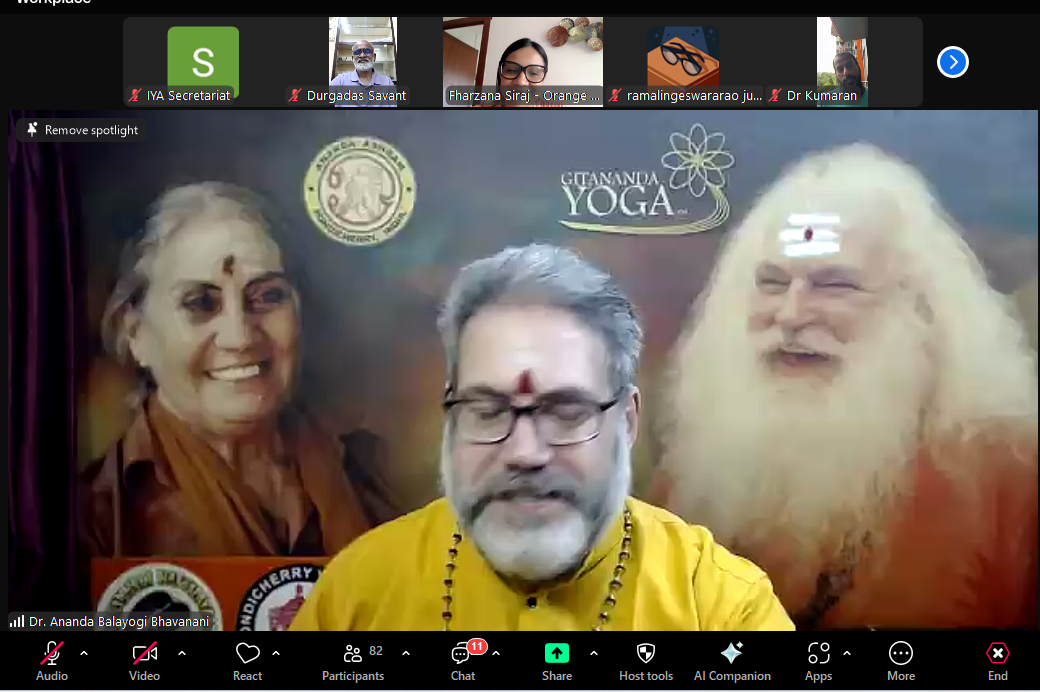
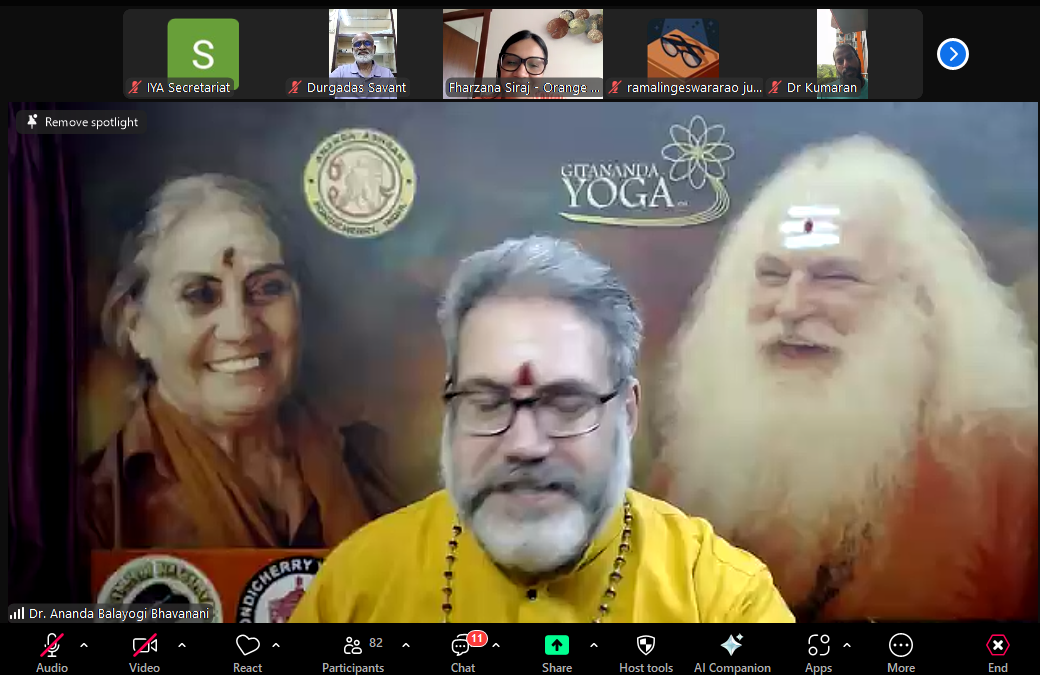
On the sacred occasion of Sri Ram Navami and the eve of World Health Day, Yogacharya Dr. Ananda Balayogi Bhavanani delivered a transformative discourse as part of the 15th session of the CYCLE program. With profound clarity and depth, he explored how Yoga Therapy, grounded in the ancient Indian tradition, is perfectly aligned with modern salutogenic principles to promote dynamic, holistic wellness.
Puduvai Kalaimamani Yogacharya Dr. Ananda Balayogi Bhavanani is the Director of the Institute of Salutogenesis and Complementary Medicine (ISCM) and Professor of Yoga Therapy at Sri Balaji Vidyapeeth, Pondicherry. A medical Gold Medalist and trained in Yoga by his renowned parents (1991–1993), he is the son and successor of Yogamaharishi Dr. Swami Gitananda Giri and Yogacharini Meenakshi Devi Bhavanani.
He serves as Joint Secretary of the Indian Yoga Association, Vice President of Yogasana Bharat, and Consultant to WHO’s Traditional Medicine initiatives. Dr. Ananda is the first Indian Certified Yoga Therapist (C-IAYT) and has authored over 35 books, 400+ papers, and received 4,000+ citations. Also a Classical Indian vocalist and choreographer, he was awarded the Puduvai Kalaimamani title in 2016 and Yoga Chikitsa Ratna in 2025.
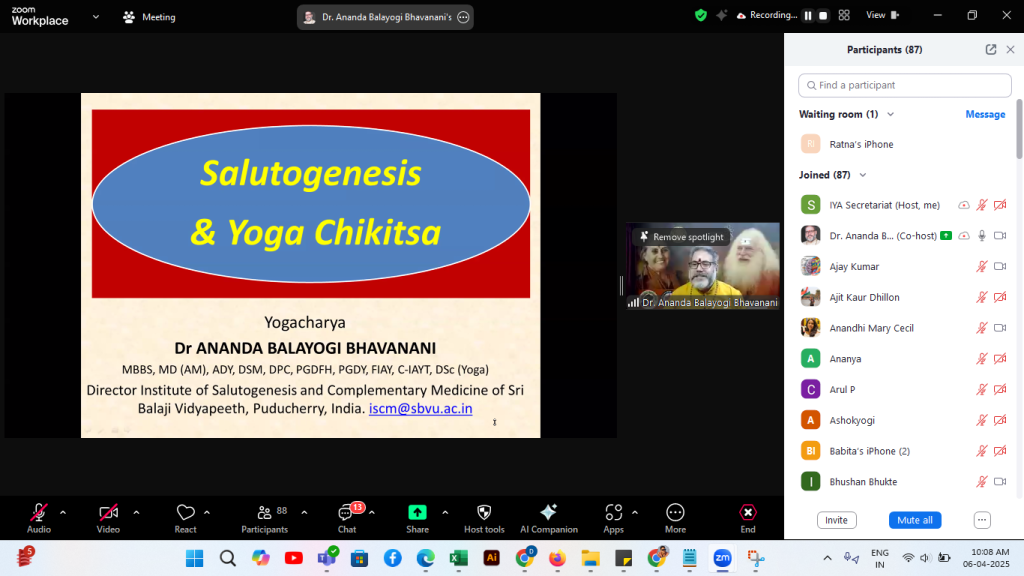
Salutogenesis & Yoga Chikitsa
Drawing from his lineage in the Gitananda Yoga Tradition, Dr. Ananda ji emphasized that Yoga is not a mat-bound routine but a 24/7 conscious way of life. He stressed that yoga therapy must remain rooted in the foundational principles of Yoga, rather than being reduced to symptom-based interventions of “yogopathy.”
At the heart of Dr. Ananda’s talk was Salutogenesis, a term coined by medical sociologist Aaron Antonovsky, which refers to the origins and development of health. Salutogenesis may be defined as all the factors involved in manifesting and sustaining a sense of well-being and wholesome wellness. The Indian equivalent of this is Swastha, a Sanskrit term meaning “to be established in the self,” or to be at ease with oneself. Acharya Sushruta (~600 BCE) defined this as a “dynamic balance of elements and humors,
normal metabolic activity, and efficient elimination—coupled with a tranquil mind, clear senses, and a contented soul” (Bhavanani, 2013).
Dr. Ananda emphasized that health is not a fixed state to be achieved, but a dynamic continuum – a concept echoed in the Yogic, Vedic, and Siddha traditions of India. This holistic vision of health includes the physical, emotional, intellectual, social, and spiritual dimensions of human experience.
In line with this view, Yoga is not merely a practice confined to the mat but a complete lifestyle. Through step-by-step development, Yoga addresses every layer of existence: beginning with ethical behavior (Yama, Niyama), continuing through physical practices of different forms (Asana), pranic regulation with breath (Pranayama), and inward focus (Pratyahara, Dharana, Dhyana), culminating in the ultimate experience of Samadhi which is the state of Universal Oneness and true integration.
Linking ancient wisdom with modern psychology, Dr. Ananda Ji explained how Antonovsky’s Sense of Coherence (SOC) comprised of comprehensibility, manageability, and meaningfulness lies at the heart of Salutogenesis. In chronic diseases, cultivating this inner coherence enables individuals to flourish even amidst physical limitations, much like how the “disabled” become “differently abled.”
The Sense of Coherence includes the following:
Comprehensibility (understanding one’s life),
Manageability (having the resources to cope), and
Meaningfulness (finding purpose).
This concept deeply resonates with Eudemonia, described by Aristotle as a “well-lived life” and finds parallels in Maslow’s self-actualization, the Japanese Ikigai, and the Indian concept of Swadharma – ‘one’s true purpose’. Yoga, thus, becomes the tool to help individuals actualize their potential and align their life with meaningful purpose.
As Dr. Ananda noted, the role of a Yoga therapist or Yoga Chikitsaka is not just to offer practices but to be a friend, guide, and mirror to help individuals truly “see” themselves. This requires deep listening, empathy, patience, and compassion. It is through this trust that therapists can help others move from a mindset of “being healthy is impossible” to a self-assured “I Am Possible.” Here, the stressor itself becomes a catalyst for transformative health.
To support this journey, Yoga promotes five key lifestyle pillars:
Achar – Healthy daily actions
Vichar – Positive thoughts and attitudes
Ahar – Nourishing, sattvic diet
Vihar – Healthy recreation and relaxation
Vyavahar – Harmonious social behavior
These practices foster resilience, strengthen self-regulation, and nourish inner peace empowering individuals to be active participants in their own healing journey rather than passive recipients of care.
Dr. Ananda ji also drew attention to the importance of General Resistance Resources (GRRs) and Specific Resistance Resources (SRRs) support systems and tools that allow individuals to bounce back from stress and illness. In this context, Yoga classes for general well-being serve as GRRs, while personalized Yoga Therapy protocols tailored to specific conditions function as SRRs.
Ultimately, Yoga is more than a therapy. It is a path of empowerment, self-realization, and connection with the cosmos. As Dr. Ananda ji passionately argued for Integrative Healthcare, where Yoga works hand-in-hand with modern medicine. In his words, “Taking the yoga out of yoga therapy leaves you with just therapy.” Thus, he called for an traditionally and culturally authentic, holistic, and evidence-informed approach to Yoga Chikitsa.
In a world increasingly overwhelmed by stress and chronic disease, the message of Yoga as a salutogenic force which is grounded in both ancient wisdom and modern science offers hope, direction, and healing. Dr. Ananda’s session was not just a lecture; it was a call to live consciously, heal holistically, and evolve purposefully.
Conclusion
In an age burdened by chronic stress and lifestyle disease, Yogacharya Dr. Ananda ji’s message is profoundly relevant: “healing is not just about surviving illness but about living fully, meaningfully, and consciously.” As both science and spirituality align, Yoga emerges as the bridge between health and wholeness. This is an ancient solution for modern living.