

Yogācārya S Sridharan
Vice President, IYA)
Past
Yoga is very ancient. Its origin is traced to Vedas, which exists from time immemorial. Vedas are broadly divided as ‘Karma Kāṇḍa’ and ‘Jñāna Kāṇḍa’. Karma Kāṇḍa is the action part which contains all the rituals associated with the Vedas. Here each and every limb of the Aṣtāñga Yoga (the eight limbed Yoga) is found in practice. Jñāna Kāṇḍa is the philosophical part of the Vedas which is full of reflections ultimately leading to the realization of the reality. Upaniṣads, which form the core part of this section, has direct references to Yoga. Immediately after the Vedas comes the Itihāsas, viz., Ramāyaṇa and Mahābhāratā. In the former Yoga Vāsiṣtā and in the later it is Bhagavad Gītā which contains the message of Yoga. Later it is Samhitās and Āgamās where a lot of references to Yoga is found. However, it is only the Yoga Darśana of Sage Patañjali, which forms part of the Darśana segment of the Vedic teaching, which is exclusively dedicated to Yoga. Even today this unique text and teaching is considered as the authority for yoga. In the Purāṇa segment of the Vedas there are references to Yoga in all the Purāṇas
Yoga being a practical subject is passed on through a lineage of teachers and are called as ‘traditions. These traditions start from the Trinity, viz., Brahma, Viṣṇu and Śiva. ‘Yoga Yajñavalkya Samhita is attributed to Brahma, Bhagavad Gītā to Viṣṇu and Haṭha Yoga Pradīpika to Śiva. Patañjali is considered as the incarnation of the Serpent God ‘Ādiśeṣa’ who serves Viṣṇu. These traditions are continuing even today, one example being the ‘Nātha Sampradaya’.

The growth of the Yoga traditions which continues even now can be compared to the Banyan Tree where every branch becomes a root. The 18th and 19th Century saw a number of notable Yogi-s who spread the message of Yoga taking it as their ordained service and devoting their life entirely for this purpose. Swami Vivekānanda (1863-1902) plays a major role in taking Yoga and Vedānta to the west.
While there are number of Yogi-s who had contributed immensely to building great yoga traditions, mention of the following four is important:
(1) Swami Kuvalayananda (1883-1966)
(2) Swami Sivananda (1887-1963)
(3) Shri Tirumala Krishnamacharya
(1888-1989)
(4) Shri Yogendra Ji (1897-1989)
All the leading Yoga Institutes such as Kaivalyadham, Yoga Institute, Sivananda Yoga centres, Krishnamacharya Yoga Mandiram bear testimony of their contributions.
Present
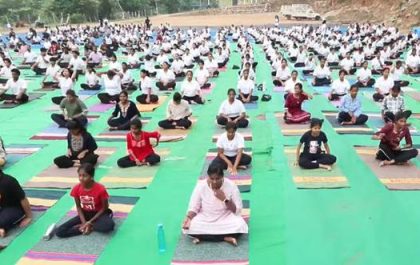
The timeline of Yoga can be divided as ‘Yoga before the IDY (International Day of Yoga)’ and ‘Yoga after the IDY’. Yoga took a quantum leap after the announcement and celebrations of IDY from 2015. Entering the eleventh year, IDY has brought a metamorphic change to Yoga. Modern science started looking into it deeply and found the immense positive effect and continues to do Research on every aspect of Yoga in human life. Its role in Therapy has been accepted by the scientific community taking it to the centre space as a ‘Supplementary’ and “Integrative Therapy’. This calls for more responsibility on the Yoga community to ensure that the quality does not deteriorate in any way.
Government on its part formed a Ministry under the name “AYUSH’ to ensure this.
The formation of the Indian Yoga Association (IYA) in 2008, is a landmark in the history of Yoga. IYA, a self-regulatory body, acts as an interface between the Government and other agencies associated with Yoga. It has an important role in preserving the traditions of Yoga. It is actively engaged in preserving the quality of Yoga.
Every University has a Yoga Department and there are independent Yoga Universities. Yoga is spreading very fast and is reaching the doorsteps of all.
Advent of computers, gadgets, etc. is impacting Yoga. Because of Covid shutdown, Yoga went online. It is continuing in a large way. Apps are coming out frequently. They can be just downloaded and with their help one can do Yoga. Yoga has become a respectable and paying profession. That has brought in many people from every walk of life to take to yoga teaching. While this is certainly a very good move, looking for instant success is the shortcoming. There is a trend of compromising personal practice in the altar of teaching which is not good.
Future
With the Artificial Intelligence (AI) entering every field of life, its entry into Yoga is not far off. It will take over basic work of documentation, preservation and research which can be good. If it enters the yoga teaching arena it can have unpleasant results. In the days to come one can look for AI managed ‘Yoga Kiosk’. One has to simply enter the Kiosk, with the help of an interactive computer all data will be taken, and a suitable yoga course will be designed and taught by the AI yoga teacher. While these developments cannot be stopped and will continue, one will have to be cautious to use them with discretion.
Yoga’s ultimate aim is to put an end to ‘suffering’ and this can be achieved only with the interaction with a ‘live’ Guru. The human touch should not be lost.