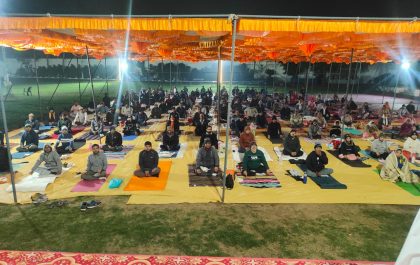


Research is extremely important to support different approaches to health care and Yoga has been gaining lot of attention as Yoga Institutes, reseachers, scholars have started offering substantive clinical research evidence. Though there has been a significant growth in research addressing the impact of yoga on health and wellbeing in the recent past, Indian Yoga Association brings to you the first Research Papers published by our Member Institutes
Swami Vivekananda Yoga Anusandhana Samsthana (SVYASA)
Title: Yoga for bronchial asthma: a controlled study
Authors: R NAGARATHNA, H R NAGENDRA
Date of Publication: 19 October 1985
Published in: British Medical Journal, Volume 291

Abstract
Fifty three patients with asthma underwent training for two weeks in an integrated set of yoga exercises, including breathing exercises, suryanamaskar, yogasana (physical postures), pranayama (breath slowing techniques), dhyana (meditation), and a devotional session, and were told to practise these exercises for 65 minutes daily. They were then compared with a control group of 53 patients with asthma matched for age, sex, and type and severity of asthma, who continued to take their usual drugs. There was a significantly greater improvement in the group who practised yoga in the weekly number of attacks of asthma, scores for drug treatment, and peak flow rate. This study shows the efficacy of yoga in the long term management of bronchial asthma, but the physiological basis for this beneficial effect needs to be examined in more detail.
Krishnamacharya Yoga Mandiram
An approach to counseling Based on Yoga sutra of Patanjali
Author: Latha Satish, Managing Trustee, Krishnamacharya Yoga Mandiram, Chennai
Date of Publication: Jan- June 2014
Published in: International Journal of Yoga and Allied Sciences
Volume: 3, Issue: 1
Abstract
Yoga related intervention studies have been following the scientific methodology which emphasizes on randomized controlled trials and an objective empirical demonstration of significant effect of treatment on the target group or conditions. However, the practical difficulties of having an adequate sample, individual variability within group and also accurate measurement of intra psychic dynamics have made it a stupendous task for the researchers to present effectiveness of yoga practices in a systematic manner. As a process oriented therapy yoga is amenable to qualitative studies and also single case analysis .The narrative descriptions of experiences and events of the interaction between therapist and the care seeker provide insights about the process of transformation.
Yoga therapy is applied in handling many psycho physiological issues. The practices are mainly technique oriented and little emphasis is given to the yoga based counseling. The individualized approach to yoga in the Krishnamacharya tradition focus on the personalizing the asana, pranayama or meditation and also providing support for transformation at physical and mental level leveraging the philosophical and practical steps provided by sage Patanjali in Yoga sutras.
This article based exclusively on individual case analysis provides the application of the conceptual understanding of mind through sutras and providing supportive practices for achieving well-being. The author also highlights the issues and limitations that may crop up while using this strategy.
The Yoga Institute
Beneficial Effects of Yoga Lifestyle on Reversibility of Ischaemic Heart Disease : Caring Heart Project of International Board of Yoga
Author: J Yogendra, Hansaji J Yogendra, S Ambardekar, RD Lele, S Shetty, M Dave, Naaznin Husein
Published on: April 2004
Published in: Journal of the Association of Physicians of India,
Volume 52
Abstract
Objectives: Yoga based lifestyle modifications have been earlier shown to be beneficial in coronary artery disease in a small number of patients. We evaluated the role of lifestyle modification based on Yoga techniques, stress management and dietary modifications in retardation of coronary artery disease.
Methods: This prospective, controlled, open trial included angiographically proven coronary artery disease patients (71 patients in study group and 42 patients in control group). They were assessed clinically, by biochemical parameters, stress myocardial perfusion and function studies and coronary angiography and on psychological parameters. The study group patients were given a family based Yoga Programme which included, control of risk factors, dietary modifications and stress management for a period of one year. The patients were assessed at baseline, at frequent intervals and at the end of one year.
Results: At the end of one year of yoga training, statistical significant changes (P<0.05) were found in serum total cholesterol (reduction by 23.3% in study group patients as compared to 4.4% in controls); serum LDL cholesterol (reduction of 26% in study group patients as compared to 2.6% in the control group), regression of disease (43.7% of study group patients v/s 31% control group on MPI and 70.4% of study group v/s 28% of control group on angiography) arrest of progression (46.5% study group v/s 33.3% control group on MPI) and progression (9.9% of study group vs 35.7% of controls on MPI, 29.6% of study group v/s 60.0% of controls on angiography). At the end of the study improvement in anxiety scores was concordant with the improvement seen in the MPI. No untoward effects of the therapy were observed.
Conclusion: Yoga based lifestyle modifications help in regression of coronary lesions and in improving myocardial perfusion. This is translated into clinical benefits and symptomatic improvement.
Ananda Ashram
Oxygen Consumption and Ventilatory Changes During Savitri Pranayama and Shavasan
Author: U. C. Rai, Madan Mohan, N. Subramanian, Swami Gitananda
Published in: Journal of Research and Education in Indian Medicine
Published on: 1982
Abstract
Oxygen consumption and ventilatory changes during savitri pranayam and shavasan were studied in nine yoga trained volunteers. Both techniques produced an immediate and appreciable decrease in oxygen consumption and minute ventilation. Ventilatory equivalent for oxygen did not change significantly. This shows that subjects trained in yoga can achieve a hypometabolic state by the practice of savitri pranayam and shavasan.
Art of Living
Title: Antidepressant efficacy of Sudarshan Kriya Yoga (SKY) in Melancholia: A Randomized Comparison with Electroconvulsive Therapy (ECT) and Imipramine
Author: N. Janakiramaiah, B.N. Gangadhar , P.J. Naga Venkatesha Murthy , M.G. Harish ,
b c D.K. Subbakrishna , A. Vedamurthachar
Published In: Journal of Affective Disorders 57 (2000) 255–259
Published On: 2000
Abstract
Sudarshan Kriya Yoga (SKY) is a procedure that involves essentially rhythmic hyperventilation at different rates of breathing. The antidepressant efficacy of SKY was demonstrated in dysthymia in a prospective, open clinical trial. This study compared the relative antidepressant efficacy of SKY in melancholia with two of the current standard treatments, electroconvulsive therapy (ECT) and imipramine (IMN). Methods: Consenting, untreated melancholic depressives (n 5 45) were hospitalized and randomized equally into three treatment groups.
They were assessed at recruitment and weekly thereafter for four weeks. Results: Significant reductions in the total scores on Beck Depression Inventory (BDI) and Hamilton Rating Scale for Depression (HRSD) occurred on successive occasions in all three groups. The groups, however, did not differ. Significant interaction between the groups and occasion of assessment occurred. At week three, the SKY group had higher scores than the ECT group but was not different from the IMN group. Remission (total HRSD score of seven or less) rates at the end of the trial were 93, 73 and 67% in the ECT, IMN and SKY groups, respectively. No clinically significant side effects were observed. Discussion: Within the limitations of the design (lack of double blind conditions), it can be concluded that, although inferior to ECT, SKY can be a potential alternative to drugs in melancholia as a first line treatment.