


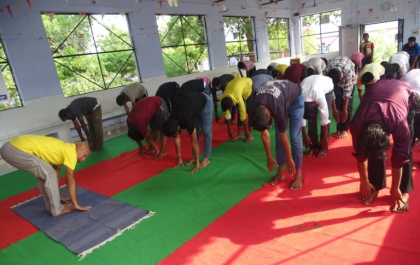
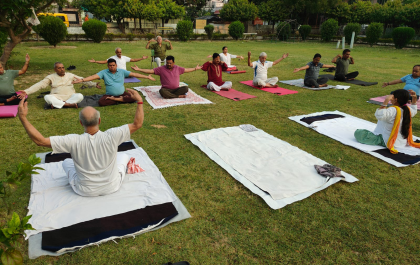
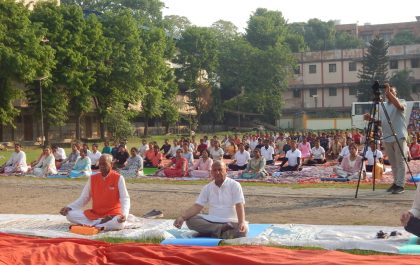


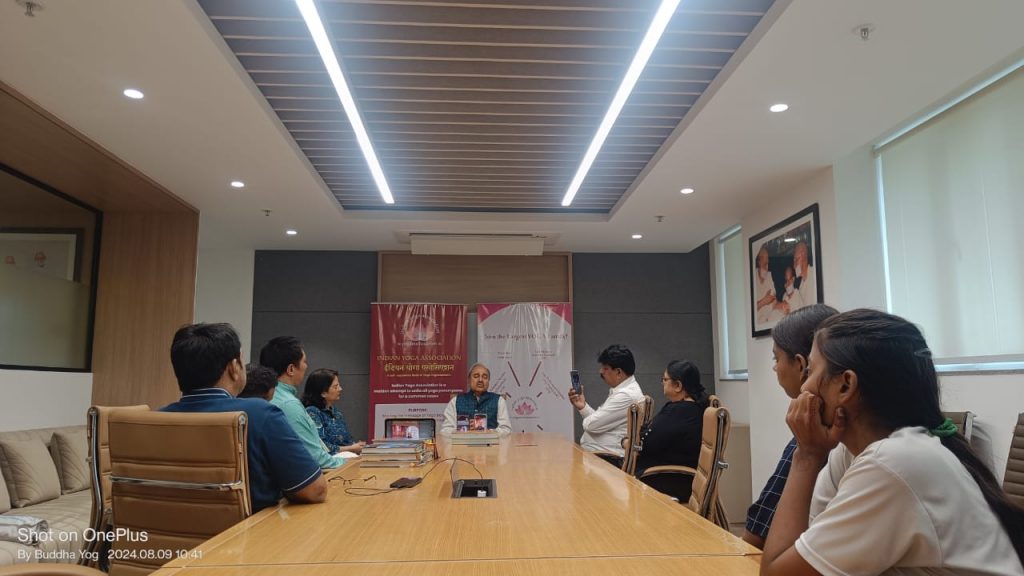
The Indian Yoga Association (IYA) has launched a new initiative, the “Manthan” monthly lecture series, aimed at fostering deeper understanding and dialogue on various aspects of yoga and wellness. The series seeks to provide a platform for experts to share their knowledge and insights, enriching the community’s appreciation of yoga as a holistic practice. The inaugural session was held on August 9, 2024, featuring Shri KC Jain, Managing Trustee of Adhyatm Sadhna Kendra, Delhi, and Treasurer of IYA. Shri Jain’s session on “The Art and Science of Breathing,” conducted at Anuvrat Bhavan, New Delhi, from 10:00 to 11:00 AM, offered participants an in-depth exploration of breath regulation techniques, blending both philosophical wisdom and scientific perspectives.
During his session, Shri Jain delved into the profound connection between breathing, health, and the balance of vital energy, highlighting both the philosophical and scientific aspects of breath regulation. The event attracted a wide audience online and offline, eager to explore the transformative potential of conscious breathing for physical and mental well-being.
He went on to explain that the ancient civilizations placed a significant emphasis on health. What is surprising is that Indian philosophy, which includes yoga, where pranayama is a crucial component, and meditation, which is another essential aspect, is entirely based on breathing. The most important thing to understand is breathing – is it just a physical process where oxygen enters the body and carbon dioxide exits. Oxygen purifies the blood and produces energy within it, while carbon dioxide, being a toxic waste is expelled. This creates a natural cycle. Carbon dioxide becomes food for plants, while the oxygen released by plants becomes nourishment for us. In this way, the cycle of nature continues.
That is one aspect of breathing, but the core aspect is that breathing is the manifestation of our vital energy. Now, one might ask, what exactly is vital energy? I am sitting in a room where the lights are on, and I can see them because of the light they emit. But what is powering the bulb? The answer is electricity. Can we see electricity? Can we sense it without any medium? No, we can’t. If there were no wires or no bulb, would we be able to perceive electricity? No. Yet, it is due to electricity that the bulb is glowing, and the fan is running.
Similarly, in our existence, there are two things at play: vital energy (prana) and the body, where this energy is manifested. Our health is like this electricity. If the current fluctuates, the bulb might fuse, and if the current is too low, the bulb won’t glow as brightly. The same applies to the body. Our vital energy is like that current. If it fluctuates or doesn’t flow smoothly, it affects our physical health.
We can understand our vital energy through three key indicators – the body, the mind, and emotions. Even a small change in the body will be reflected in our breathing pattern. For example, if your stomach is full, your breathing will be shallow because your abdomen cannot fully expand due to the food inside. On the other hand, when your stomach is empty, your breath will be longer and deeper.
You can test this yourself. When we have a fever, for example, our breathing becomes erratic. We try to control it, but we can’t. The body’s prana is out of balance. This is why when we are physically unwell, our vital energy is disturbed, and this imbalance is manifested in our breathing patterns.
Interestingly, the West is conducting extensive research on how breathing patterns can be measured to determine the health of an individual. There is no need for extensive medical tests like hemoglobin or sugar tests, or advanced scans like CT, PET, MRI, or even angiography. Merely by observing one’s breathing rate and rhythm, experts can determine what kind of health issues might be present. This shouldn’t come as a surprise because Ayurveda, too, relies on similar techniques. Ayurvedic practitioners, by merely feeling the pulse, can diagnose imbalances in vata, pitta, and kapha.
In terms of the body’s energy channels, we refer to ida, pingala, and sushumna, and if we view it from an electrical standpoint, we could call it negative, positive, and neutral currents. By feeling the pulse, an experienced practitioner can tell what kind of ailment exists, whether it’s a stomach issue or something else.
This suggests that changes in our vibrations cause changes in our physical health, and a thorough study can reveal the type of ailment we are dealing with. Another aspect is the mind – thoughts arise in the mind, and the intellect analyzes them. As the pace and nature of our thoughts change, our breathing pattern also changes accordingly. Just like light and darkness cannot coexist, similarly, changes in thoughts will lead to changes in breathing, which in turn affects our health.
Everything is interconnected – breathing, thoughts, emotions – they are all two sides of the same coin. Whenever there’s a change in one, it impacts the others. For instance, when you’re angry, your breath quickens; when you’re calm, your breathing becomes slow and rhythmic. When you’re afraid, your breathing becomes erratic, but when you regain composure, your breath normalizes.
On the negative side, emotions like anger, greed, lust, jealousy, and arrogance cause the breath to flow in one way, while on the positive side, emotions like love, compassion, peace, and non-violence cause the breath to flow differently. This is a fundamental law of nature, one that we cannot change but can certainly understand. By bringing about changes in our breathing patterns, we can also bring changes to our physical, mental, and emotional well-being. Nature has placed this key in our hands, and it is available only to humans.
Understanding this key gives us the power to harmonize our health, body, and mind. The session concluded with a breathing practice and a question answer session.