Practice of the Month
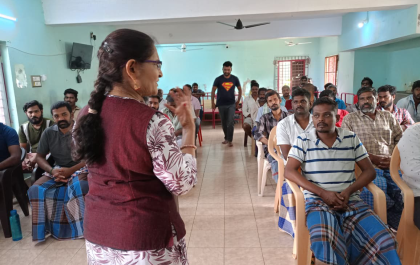
ISCM and Puducherry SCC promotes Yoga & Music Therapy for De-addiction 
The Institute of Salutogenesis and Complementary Medicine (ISCM) of Sri Balaji Vidyapeeth (SBV), in association with the Mother Care Foundation (MCF)—a centre for alcohol and cannabis de-addiction and rehabilitation; organised and conducted an awareness program on de-addiction and rehabilitation — in collaboration with the Indian...
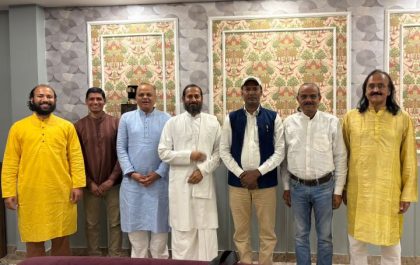
Bihar SCC convenes meeting, adopts strategic resolutions 
he Bihar State Chapter Committee of the Indian Yoga Association convened its meeting on 27 February 2026 from 5:00 pm to 7:00 pm at Energy Yoga Healing Centre, Patna. The meeting was attended by all newly appointed Executive Committee members and focused on strengthening the...
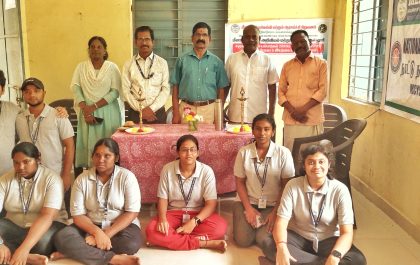
MAHER spearheads community wellness initiative 
Reaffirming its commitment to community well-being and the propagation of yoga, the Faculty of Yoga Sciences and Therapy (FYST), Meenakshi Academy of Higher Education & Research, Chennai — an Associate Centre of the Indian Yoga Association — conducted a five-day Social Service Activities and Free...
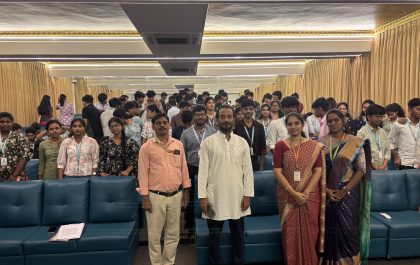
Oordhvam Yoga marked National Youth Day with inspiring workshop at SIMATS, Chennai 
On the occasion of National Youth Day, Dr. Kaushik R, Founder of Oordhvam Yoga, an Associate Centre of the Indian Yoga Association, delivered an inspiring one-day workshop titled “Elevate Your Well-Being: Tools for Calm Minds, Healthy Bodies & Stronger Connections.” The session took place at...
Yogis Foundation successfully held yoga and meditation camp in Ambasamudram 
The Yogis Foundation successfully held a two-day Yoga and Meditation Camp on 7th and 8th February 2026 at the Yogis Meditation Center, Ambasamudram, Tirunelveli District, Tamil Nadu. The camp witnessed enthusiastic participation from aspirants and yoga practitioners representing various regions across the state. Designed as...
S V Yogalaya, Chennai celebrates Republic Day, Ratha Saptami and hosts insightful Tapas Yoga Club session 
S V Yogalaya, Arumbakkam, Chennai, an Associate Centre of the Indian Yoga Association, marked significant occasions with devotion, discipline, and yogic awareness through a series of meaningful programmes. On the occasion of Republic Day, a grand archery event was organized at S V Yoga Center,...
YogaPeace Sansthan organises “Anandam” programme to promote joyful living through yoga in rural Nepal 
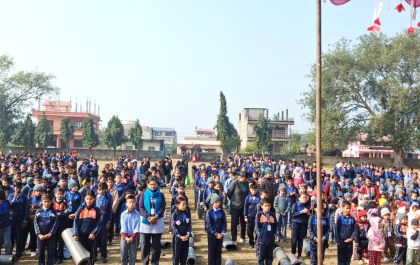
Under the joint aegis of YogaPeace Sansthan and the Indian Yoga Association, an inspiring yoga-awareness programme titled “Anandam – How to Live Joyfully in Life” was successfully organized at Tribhuwan Higher Secondary School, Shankar Pokhari 33400, Ward No. 3, Pakhar Chor Parvat, Nepal. The programme...
Grand celebration of the 11th Surya Namaskar Vinyasa in Mumbai with over 200 participants 
Swayamsiddha Yoga, an Associate Centre of the Indian Yoga Association, successfully organized its 11th Surya Namaskar Vinyasa with great enthusiasm and participation. Dedicated to the promotion of yoga for the past 30 years, the institution conducted this grand event under the able guidance of Yogacharya...
Art of Living with Gujarat SCC successfully organizes Yoga Mahotsav 
In a vibrant celebration of yoga and collective wellness, the Art of Living, in collaboration with the Indian Yoga Association – Gujarat Chapter, successfully organized Yoga Mahotsav at Deesa, Gujarat. The grand event witnessed the enthusiastic participation of more than 300 yoga practitioners and wellness...
Universal Peace Foundation conducts series of spiritual, educational and national events at Thirumoorthi Hills 
The Universal Peace Foundation, an Associate Centre of the Indian Yoga Association, organized a series of spiritually enriching, educational, and nationally significant programmes during January and February 2026 at its Gnanapeedam, Thirumoorthi Hills. These events reflected the Foundation’s continued commitment to youth empowerment, spiritual awakening,...


Book your PRINT copies

[wpforms id=”2536″ title=”false” description=”false”]
14 Apr 2026

Blog

Traditional Methods of Obtaining “Proof” in Spiritual Research
Editorial

Traditional Methods of Obtaining “Proof” in Spiritual Research 

Modern science is often caught up with trying to prove “existence” through empirical studies. This trend has come into Indian traditional circles and we find many asking for “proof” in this regard.

It is vital to understand that the modern scientific research methods are not the only ones to be accepted. The Indian tradition has numerous methodologies and we need to open our minds and hearts to understand that there are more ways to realisation of the truth and reality than just the popular RCTs (Randomised Controlled Trials) of Pharmaceutical driven research studies.

Methods of gathering evidence of the reality were called Pranama and according to Indian traditions; Pramana refers to the obtaining, attaining and experiencing of a valid and appropriate knowledge or wisdom.

In the Yoga Darshan, Maharishi Patanjali provides us with the three fold methodology to attain Pramana.

pratyaksha anumana agamah pramanani-Yoga Sutra (1.7)

He says Pratyaksha (direct perception), Anumaana (inference) and Aagama (reliable testimony) are these methods. Sometimes Shabda is also used instead of Aagama.

Our capacity for direct perception is based on the refinement of both our cognitive and sensory competence and hence in the Yoga tradition great emphasis was placed on Pranayama, Pratyahara and Dharana as methods to refine these tools. Through Pranayama Sadhana one gets clarity of mind and then one can transcend the sensory inputs and perceive the reality from “above” through clear cognition.

Then the one pointed focussed mind will enable the reality to be clearly understood.
As suggested by my dear Alessandro Garcea, “The problem of ‘proof’ in spiritual research is extremely important, notwithstanding the specific path that one has chosen. But, also in this field, Indian world can give us the right answer that other Traditions have lost. If we admit that the observer is relevant in every process of verification, then we must recognize that the result of the verification varies according to the evolution of the observer him/herself”.

A very pertinent point indeed from a dedicated Sadhaka.

This preparation is part of the Sadhana that must be undertaken by a Sadhaka or researcher to understand the next level of evidence which is based on inference. One must have a clear head to make a hypothesis (pratijna), find the core reason behind the manifestation (hetu) and then be experienced enough to create and express clear examples and metaphors (drshtanta).

The hypothesis involves both the idea to be tested and the object on which it is to be tested. If one is able to find continuous positive examples then the hypothesis gets accepted and if not it is negated. Similarly negative examples become counter evidence that then negates the original hypothesis.

Indian traditions have maintained high levels of rigour by demanding that the reason (hetu) must always and independently account for the inference in “all” cases, both in cases of positive as well as negative findings.

Shraddha is an important attribute of true Sadhaka and hence one learns to trust and accept the reliable testimony in the form of Aagama or Shabda. These sources may be Vaidika when one is accepting as a valid source of reference the statements and teachings of the Rishis in the Vedas. It may also be Laukika which is the usage of more common, yet trustworthy human sources.

The Advaita Vedanta and Mimamsa Darshanas often also use other methods such as Upamaana which refers to comparative analysis and Arthapatti that is based on hypothetical postulates of common sense. Nyaya Darshan accepts Upamaana too.
Anupalabdhi or Abhaava which is the cognitive proof using methods of non-perception or non-existence is often used in Advaita Vedanta as seen in many of the compositions of Sri Adi Shankara.

I think that it is time we take another look at these levels of evidence and explore how they can be incorporated in the research studies being done in the Indic systems.
If we can find common ground between them and the modern methods, we may just be able to make the biggest breakthrough in human scientific inquiry.

Related posts