



-by Sadhguru, Isha Foundation
Today, every major bookstore stocks at least 10 books about how you can learn yoga in a week or become a yogi in three. Yoga may seem to be very simple, but when you do the practices, you will see there is a very subtle aspect to them. Many people have caused immense damage to themselves by learning yoga through books.
Objective and subjective technologies are different. Let’s say you are conducting a chemistry experiment. You put one chemical into another, watch and note your observations. This is objective technology. But when it comes to subjective technology, both chemical and chemist are you. Unless you put yourself into it, it won’t happen. This requires a different kind of atmosphere, where there is the necessary level of commitment and focus. Otherwise, you will completely miss the subjective aspects of life.
Unfortunately, in so many places, only the objective aspect of yoga is available, without the subjectivity. People say that by twisting your body like this and breathing like that, this will happen or that will happen. No. Without the subjectivity, it is like a stillbirth. Not having a child is better than having a stillborn child, isn’t it? Right now, the body of yoga has arrived without the subjectivity. The subjective aspects of life are being handled as if they are objective. What is subjective will not come from a book. It takes the involvement of a human being.
Yoga is not a form of exercise. Yoga is a science through which a dimension beyond the physical becomes a living reality within you. This is a technology that renders you to a higher possibility. Anything that has tremendous transformative power can also cause damage when handled improperly. This is why yoga is always taught in a committed atmosphere.
There are other practices, known as upa-yoga, which do not demand that sort of commitment because they are very simple, and they have only physical and psychological benefits. They do not touch the spiritual dimension. But yoga itself should be done with proper understanding and guidance. Otherwise, it can be lots of trouble.
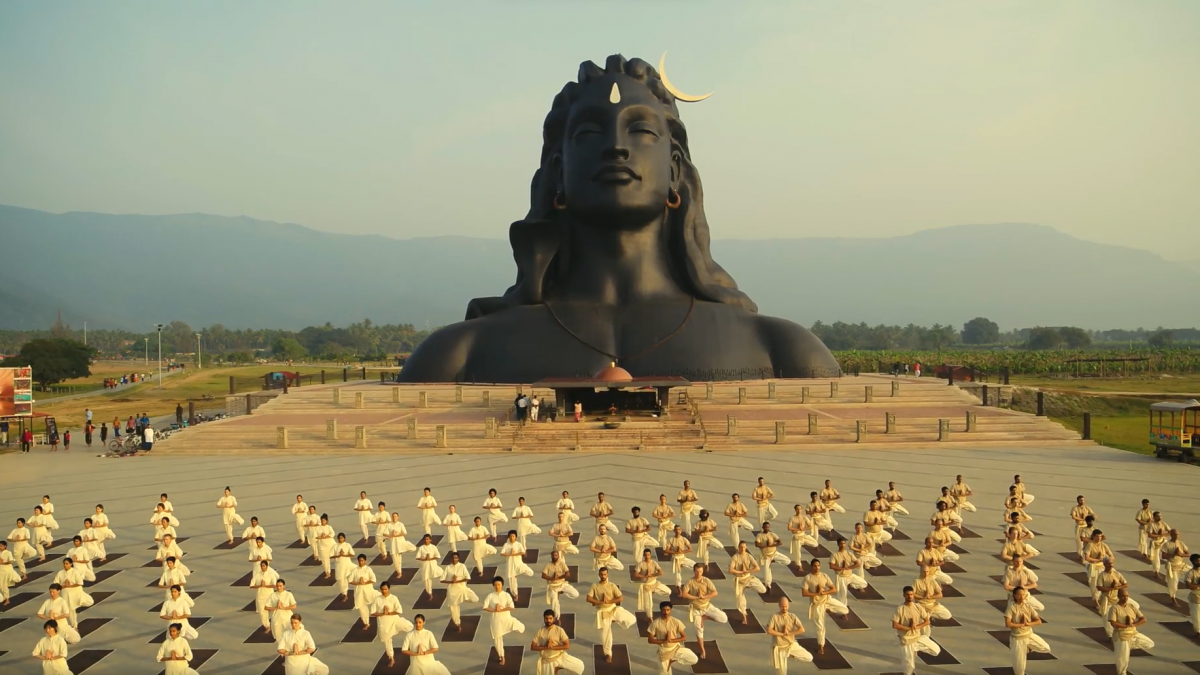
When Adiyogi, the first yogi, transmitted the yogic sciences to his seven disciples over 15000 years ago, he explored and expounded various dimensions of technology. At the same time, he made it a kind of taboo to transmit the technology. When he gave preparatory practices to the seven disciples, today revered as the Saptarishis, he gave them the technology. But once they came to a certain level, he gave them only pure science because he knew that once you know the fundamentals of the science, according to the need around you, you will develop technology.
A serious mistake that modern cultures are making today is that we are not developing technology according to the needs. When people touch upon something, they don’t evaluate whether this technology is needed for us or not. We develop a technology and try to arrange life around that. Just about anything that we are capable of doing, we do, and after fifty years, we regret it and say this was not the right thing to do.
You will see, as time goes by, we will have many regrets about the development of technology and how it is destroying our life on a daily basis. This generation of people is kind of mesmerized by technology. They have lost their sense with it. If you maintain your sense, technology can be a great boon. If you don’t maintain your sense, technology will take away our lives.
This is the reason why even yogasanas are not written down in any of the texts. But today, some writers claim that since there is no mention of yogasanas in any yogic text, they must have been copied from European exercise systems! In the last few years, several books have been written claiming this.
But yoga is not some recent invention. It has been around for thousands of years. People don’t find any history about yoga because only the philosophy of it was written down, never the practices. In some temples, you see carvings of yoga postures, but even those were not instructional in nature, they were just a décor. The practices were always a living tradition. We always saw a practice must be learnt in person from someone who knows how to do it.
Even in the Yoga Sutras, Patanjali does not teach any practice. He did this intentionally. Patanjali is referred to as the father of modern yoga. He did not invent yoga.
When he came, yoga was already present in different forms, which Patanjali assimilated into a system. Over 15000 years ago, on the banks of Kantisarovar, a lake a few kilometers beyond Kedarnath, Shiva, the Adiyogi, transmitted yoga to the Saptarishis. Adiyogi had the highest understanding of human nature, but nothing was put into writing. He was too wild for that. When he found that putting everything he knew into one person was not possible, he chose these seven people and put different aspects into each. And so, we have seven basic forms of yoga, which have branched off into hundreds of systems today. But you can still see these seven distinct forms.
Patanjali’s work was essentially to assimilate these hundreds of systems, which were so diversified and complex that no one was able to utilize them in a meaningful manner. Patanjali included all these aspects into the format of the Yoga Sutras. Literally, the word “sutra” means “thread.” The Yoga Sutras are like formulas. In physics, a formula such as Einstein’s E=mc2 is just a small bunch of English alphabets. But an immense amount of science is present in it. It is the same with the sutras. People have tried to implement them as it is, out of ignorance. But you do not wear a garland for its thread – though a garland is not possible without the thread. Each master makes his own garland with the thread. You can put flowers, beads, pearls or diamonds on it. The thread is vital but that is not a goal by itself.
So, throughout history, only the science was supposed to be transmitted in yoga, not the technology. In the preparatory stages, technology is important and sadhana is given. But after that, only science is important.
Ranked amongst the fifty most influential people in India, Sadhguru is a Yogi, mystic, visionary and a New York Times bestselling author. Sadhguru has been conferred the Padma Vibhushan by the Government of India in 2017, the highest annual civilian award, accorded for exceptional and distinguished service. He is also the founder of the world’s largest people’s movement, Conscious Planet – Save Soil, which has touched over 4 billion people.