

Introduction:
In contemporary culture, the word karma is often reduced to a simplistic notion of reward and punishment: “what goes around comes around.” Popular understanding treats karma almost as a cosmic bookkeeping system that distributes fortune or misfortune according to one’s deeds. However, the classical Indian yogic tradition presents a far more nuanced, psychological, and deeply scientific understanding of karma.
From the perspective of Maharishi Patanjali’s Yoga Darshana, karma is not merely an external law governing events in the world. Karma is the subtle mechanism through which consciousness becomes conditioned. Every thought, emotion, intention, perception, and action leaves impressions upon the mind-field (chitta). These impressions gradually shape personality, tendencies, habits, cognition, emotional reactivity, and ultimately destiny itself.


The yogic understanding of karma therefore extends beyond morality into the realms of psychology, neuroscience, behavioural conditioning, and consciousness studies. Ancient Indian seers perceived that human suffering does not arise merely from circumstances, but from unconscious patterns embedded within the psyche. Modern science increasingly validates this insight through discoveries in neuroplasticity, habit formation, stress physiology, psychoneuroimmunology, and epigenetics.
The science of karma is thus not merely metaphysical speculation. It is a profound exploration of how repeated patterns of thought and action shape the human organism at physical, mental, emotional, and energetic levels.
Karma in Yoga Darshana
The Sanskrit word karma derives from the root kri, meaning “to act.” In yogic philosophy, karma encompasses far more than physical action alone. It includes:
Thoughts
Emotions
Intentions
Speech
Behavioural tendencies
Psychological reactions
Subconscious impulses
Maharishi Patanjali’s Yoga Sutra explain that human suffering arises due to the pancha klesha — ignorance (avidya), ego-identification (asmita), attachment (raga), aversion (dvesha), and fear-based clinging (abhinivesha). These klesha generates actions rooted in unconsciousness, which in turn creates deeper conditioning.
Thus, karma is intimately connected to the cyclical nature of conditioning:
Thought -> Action -> Impression -> Tendency -> Habit -> Character -> Destiny.
Modern psychology describes similar loops through behavioural reinforcement theory and neural conditioning. Repeated behaviours strengthen neural pathways, making future repetition more likely. The yogic sages observed this same process thousands of years ago through direct meditative insight.

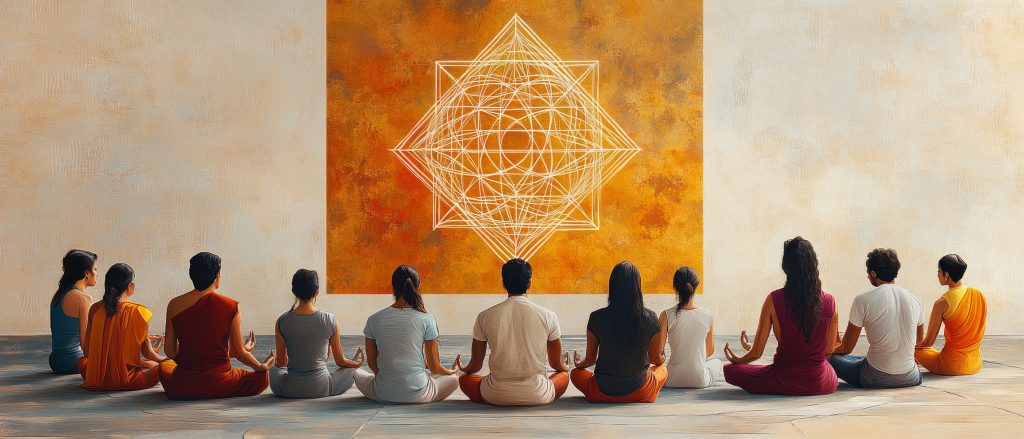
Yoga therefore seeks not merely behavioural correction, but purification of the very source from which behaviour emerges.
Karma as Conditioning of Consciousness
The yogic model of the mind proposes that every experience leaves behind a subtle impression known as a samskara. These samskara accumulate over time and influence perception, emotion, and future action.
Modern neuroscience parallels this understanding through the principle of neuroplasticity — the brain’s ability to reorganize itself based on repeated experiences and behaviours.
Neurons that repeatedly fire together form stronger synaptic connections. Over time, repeated emotional states and behaviours become automatic patterns. Chronic anger strengthens anger pathways. Repeated fear strengthens fear circuits. Compassion, mindfulness, and equanimity similarly create new neural patterns.
This is remarkably close to the yogic understanding that repeated karmic patterns deepen samskaric grooves within consciousness.
The sages therefore understood that karma is not punishment imposed externally by a deity. Karma is self-conditioning through repeated unconscious participation in mental and behavioural patterns.
The Neuroscience of Karma – Habit Loops and Automaticity
Modern neuroscience demonstrates that much of human behaviour is automatic rather than conscious. The basal ganglia, a region associated with habit formation, stores repeated behavioural patterns, allowing actions to occur with minimal conscious effort.
Similarly, yoga teaches that most human beings function through vasana — subconscious tendencies that drive behaviour automatically. Without awareness, life becomes mechanical.
This explains why individuals repeatedly engage in patterns they intellectually know are harmful:
addictive behaviour,
destructive relationships,
compulsive anger,
anxiety loops,
emotional reactivity, and
self-sabotage.
Yoga identifies these as karmic tendencies operating beneath conscious awareness.
Meditative practices interrupt these automatic loops by increasing self-observation and enhancing activity in regions associated with executive control and emotional regulation, particularly the prefrontal cortex.
Thus, yogic awareness transforms karma by bringing unconscious patterns into conscious observation.
Stress Physiology and Karmic Reactivity
The modern nervous system exists in a state of chronic overstimulation. Constant sensory bombardment, digital hyperconnectivity, emotional stress, and cognitive overload activate the sympathetic nervous system continuously.
From a yogic perspective, such chronic agitation increases rajas — the guna associated with restlessness, overactivity, impulsivity, and mental turbulence. This rajasic state generates reactive karma. When the nervous system remains dysregulated:
emotional impulsivity increases,
cognitive clarity decreases,
fear responses dominate, and
decision-making becomes reactive rather than conscious.
Scientific studies show that chronic stress elevates cortisol levels, impairs immune function, disrupts digestion, affects sleep cycles, and alters emotional processing.
Yoga recognized this
psychophysiological relationship long before modern medicine. Yogic practices were designed specifically to reduce rajasic overactivation and cultivate sattva — clarity, harmony, balance, and higher discernment.
Increased sattva enhances the human capacity for conscious action rather than conditioned reaction.
Karma and the Tri-Guna
The doctrine of the tri-guna provides one of the most sophisticated psychological frameworks in Indian philosophy.
The three guna s are:
Tamas — inertia, ignorance, dullness
Rajas — activity, restlessness, agitation
Sattva — harmony, clarity, wisdom
All karmic activity emerges through the interplay of these three forces.
Tamasic Karma:
Actions rooted in ignorance, laziness, confusion, violence, or apathy create deeper unconsciousness and suffering.
Rajasic Karma:
Actions driven by ambition, craving, competition, ego, attachment, and constant activity generate agitation and psychological instability.
Sattvic Karma:
Actions arising from awareness, compassion, balance, service, and wisdom purify consciousness and enhance inner stability.
Modern psychology similarly distinguishes between impulsive/reactive behaviour and reflective/self-regulated behaviour. Sattvic functioning correlates strongly with emotional regulation, resilience, prosocial behaviour, and psychological well-being.
Thus, the cultivation of sattva may be understood not only spiritually, but neuropsychologically.
Karma Yoga: The Transformation of Action
The Bhagavad Gita introduces one of humanity’s greatest psychological and spiritual teachings: Karma Yoga.
Karma Yoga does not mean withdrawal from action. Rather, it transforms the inner orientation behind action. The Gita teaches: “act without attachment, perform duty without ego-identification, surrender outcomes, maintain equanimity, and offer action to a higher consciousness”.
This teaching has profound psychological implications. Attachment to outcomes produces anxiety, fear of failure, comparison, chronic dissatisfaction, and emotional exhaustion. Research in positive psychology and mindfulness studies demonstrates that excessive outcome fixation correlates with stress and reduced well-being. Process-oriented engagement, however, enhances flow states, intrinsic motivation, and psychological resilience.
Karma Yoga therefore functions as a sophisticated method of cognitive-emotional regulation.
Action becomes meditation.
Daily life becomes spiritual practice.
Epigenetics and Intergenerational Karma
One of the most fascinating modern scientific developments relevant to karma is epigenetics. Epigenetics demonstrates that environmental experiences, stress, trauma, lifestyle, and behavioural patterns can influence gene expression and potentially affect future generations.
This does not prove metaphysical karma in a literal sense. However, it strongly supports the yogic insight that actions leave consequences extending beyond immediate visible effects. Trauma patterns, emotional conditioning, and behavioural tendencies can propagate across generations biologically, psychologically, and socially.
The yogic tradition has long maintained that unresolved samskara perpetuate suffering until brought into awareness and transformed.
The Role of Awareness in Transforming Karma
Yoga repeatedly emphasizes one central principle:
Awareness transforms karma. Without awareness; action becomes compulsion; thought becomes conditioning; emotion becomes bondage.
With awareness; reaction becomes response; compulsion becomes choice; conditioning becomes transformation.
Modern neuroscience supports this through findings on mindfulness-based interventions, which demonstrate measurable changes in:
emotional regulation,
stress reduction,
attentional control,
cognitive flexibility, and
neural integration.
Meditative awareness weakens automatic reactivity and strengthens conscious regulation. In yogic terms, awareness gradually burns karmic conditioning through the fire of consciousness.
Karma, Consciousness, and Human Evolution
The yogic sages viewed human life not merely as biological existence, but as an opportunity for evolution of consciousness. The purpose of yoga is therefore not simply physical fitness or stress management. It is liberation from unconscious karmic conditioning. Every moment presents a choice : unconscious reaction or conscious response, craving or contentment, ego or surrender, agitation or awareness,
bondage or freedom.
This capacity for conscious choice is one of the greatest powers of the human being.
Modern civilization has advanced technologically, yet psychologically humanity often remains deeply reactive, fragmented, and externally driven. The science of karma reminds us that true evolution is inward.
Without transformation of consciousness, external progress alone cannot eliminate suffering.
Conclusion
The yogic doctrine of karma is not a primitive superstition, nor merely a religious belief. It is a sophisticated science of human conditioning and transformation. Long before neuroscience, psychology, and behavioural science emerged, the Indian rishis recognized the conditioning power of repeated thought and action, the role of subconscious impressions, the impact of emotional states on behaviour, the importance of awareness, and the possibility of inner transformation.
Modern science increasingly validates these ancient insights.
Karma therefore must be understood not as fatalistic destiny, but as dynamic conditioning that can be transformed through awareness, discipline, sattvic living, and yogic practice. The ultimate teaching of yoga is profoundly empowering : human beings are not prisoners of conditioning. Through awareness, conscious action, and spiritual practice, karma can evolve from bondage into liberation.
And in that transformation lies the true purpose of yoga.
by Yogacharini Anandhi and Yogacharya Dr Ananda Balayogi Bhavanani
Founders Sannidhi (www.sannidhi.yoga) Pondicherry, India.