
A brief Report by Yogasadhaka Nilachal
Introduction
The CYCLE (Continuous Yoga Chikitsa Learning and Education) program continues to bring together experts who share new insights in yoga therapy and healing.
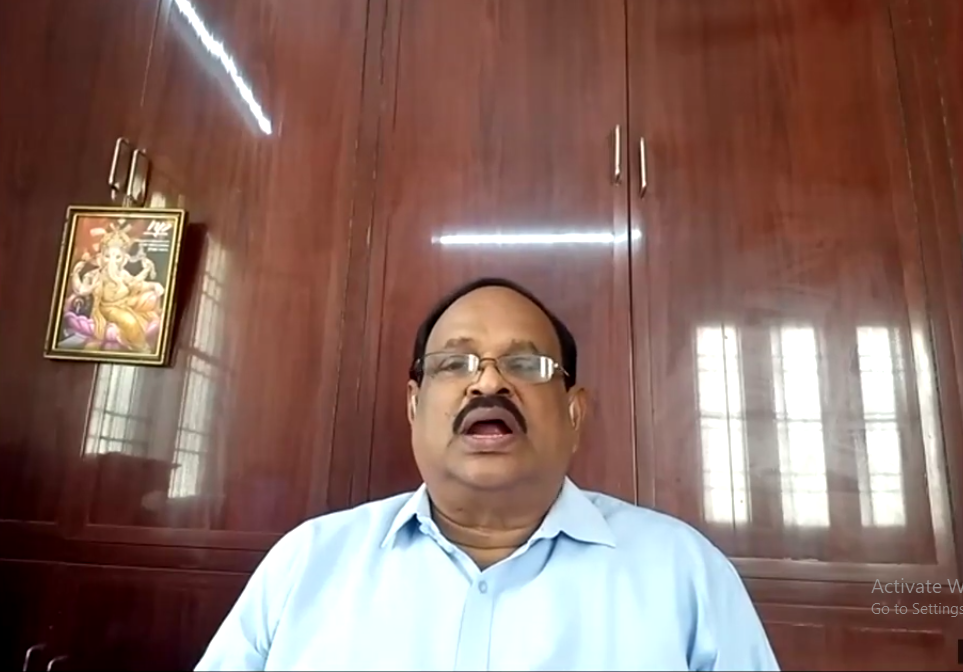
In this session, Prof. Dr. R. Elangovan offered a fresh and practical look at rehabilitation through yoga showing how it can go beyond physical recovery to restore total well-being. He emphasized that true healing means rebuilding balance in body, mind, and spirit, making yoga therapy a complete system for modern health and rehabilitation.
He emphasized that rehabilitation is not about returning to normal, but about restoring balance and wholeness in body, mind, and spirit. His message was simple yet profound:
“Yoga therapy helps rebuild life, not just muscles or movement.”
Prof. Dr. R. Elangovan ji is one of India’s most respected figures in yoga education and therapy. A teacher, researcher, and institution builder, he has dedicated over four decades to advancing the academic and therapeutic dimensions of yoga.


Currently serving as an Executive Council Member of the Indian Yoga Association (IYA) and Secretary of its Tamil Nadu Chapter, he has been instrumental in bringing yoga therapy into universities, hospitals, and public health systems.
He was the first Professor of Yoga under the Government of Tamil Nadu, has guided more than 50 PhD scholars, and authored seven influential books. Dr. Elangovan highlighted how yoga’s ancient framework aligns with modern physiology, especially in addressing the growing burden of chronic, lifestyle, and psychosomatic disorders.
New Dimensions in Yoga Rehabilitation
- From Therapy to Rehabilitation Science
He proposed that yoga therapy should no longer be viewed merely as supportive care but as a core system of rehabilitation, capable of addressing neuromuscular, emotional, and cognitive dysfunctions.
“Rehabilitation is not recovery, it’s renewal,” he said, describing yoga as a process of retraining both body and consciousness.
- Updated Diagnostic Perspective
For the first time in a CYCLE lecture, the traditional Darśana, Sparśana, Praśna, and Nāḍī Parīkṣā model was discussed as a structured diagnostic framework, blending yogic intuition with clinical precision. - Personalized Practice through Brahmana–Langhana–Samana
He revisited the classical trio: Brahmana (nourishing), Langhana (reducing), and Samana (balancing) linking them to modern metabolic states. This framework offers yoga therapists a scientific method to design personalized sessions based on energy balance and recovery goals. - Diet as an Extension of Therapy
Emphasizing the therapeutic value of nutrition, Dr. Elangovan ji connected sattvic dietary principles with current nutritional science, noting how anti-inflammatory foods accelerate tissue repair and mental clarity.
“When your diet is light, your mind becomes bright,” he said, reminding practitioners that what you eat is as important as what you practice.
Scientific Foundation of Yoga Therapy
“Yoga is surgery without instruments.”
Dr. Elangovan ji presented data showing how yoga influences the body at molecular and neurological levels:
Improves gene regulation and immune response
Balances neurotransmitters like serotonin and dopamine
Enhances neuroplasticity and cellular longevity
Regulates hormones and circadian rhythms
He explained that consistent yogic practice “tunes” the nervous and endocrine systems — restoring stability in mood, metabolism, and immunity.
Yoga Therapy Meets Modern Medicine
“Tomorrow’s therapy rooms will look like yoga halls: peaceful, mindful, and alive.”
Dr. Elangovan ji discussed how the next wave of yoga research will move toward Yoga Therapy 2.0, integrating traditional techniques with emerging technologies like:
AI-assisted health tracking
Virtual Reality (VR) meditation
Biofeedback-based emotional regulation
Integrative models recognized by WHO and AYUSH
He predicted that in the near future, yoga therapy centers will collaborate directly with hospitals as complementary rehabilitation hubs, combining asana, breathwork, and counseling with mainstream medical care.
Key Takeaways for Practitioners
Think rehabilitation, not just treatment. Yoga therapy is a long-term journey of rebuilding vitality.
Diagnose holistically. Observe, touch, listen, and sense, not just measure.
Match practice to need. Use Brahmana, Langhana, and Samana principles intelligently.
Integrate diet and lifestyle. Food and sleep are therapy too.
Measure and document results. Bring credibility through evidence-based practice.
Conclusion
“The world already believes in yoga. Now it’s time for India to prove it scientifically.”
Dr. Elangovan ji urged young yoga professionals to become both practitioners and researchers, saying that the future of yoga therapy depends on data, documentation, and disciplined compassion. He stressed that while India gave yoga to the world, it must now lead in scientific validation and global implementation.
Prof. Dr. R. Elangovan’s insights connected ancient therapeutic logic with modern physiological understanding, giving yoga therapists a clearer, evidence-based framework for personalized healing.
His message was both practical and profound: rehabilitation is not about returning to what was lost but awakening what remains. As yoga therapy continues to evolve, his work reminds us that balance, awareness, and compassion remain its true medicine.