
A brief Report by Yogasadhaka Nilachal
Introduction
Low back pain (LBP) is one of the most widespread health issues of modern times, affecting people across professions and ages. From sedentary office workers and manual laborers to athletes and seniors, the discomfort is universal, but the solution, as highlighted in the 20th edition of the CYCLE Program by the Indian Yoga Association (IYA), is often closer than we think.
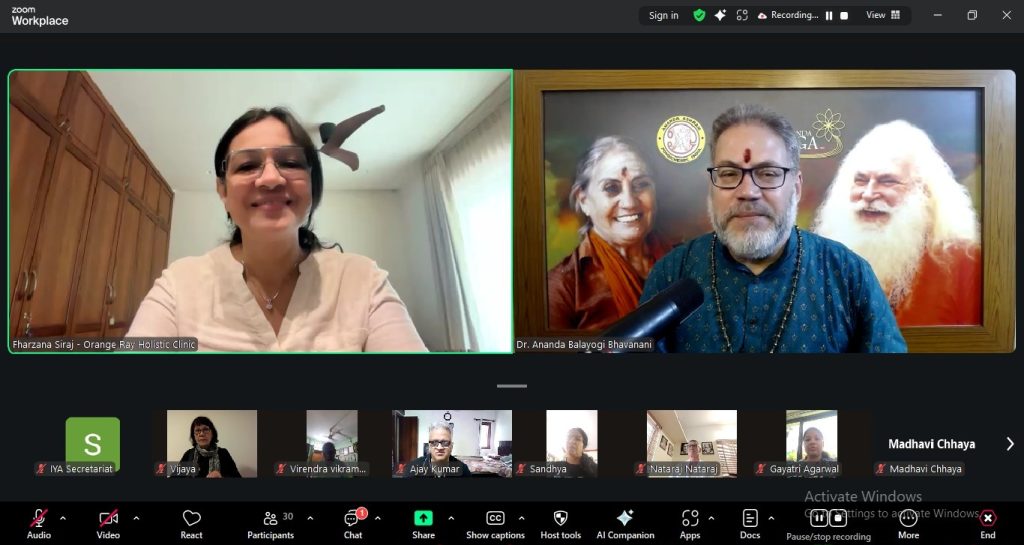
Her session “Backing Up with Yoga Therapy: Free Yourself from Back Pain” that healing often lies not in surgery but in evidence-based yoga therapy. Having overcome chronic back pain herself, Dr. Fharzana Siraj blended clinical insight, yogic philosophy, and personal experience to demonstrate yoga’s power as a compassionate tool for recovery.
A yoga therapist, acupuncturist, and nutrition coach trained under Guruji B.K.S. Iyengar, Dr. Siraj holds a Ph.D. and post-graduation in Yoga Therapy from SVYASA University, Bengaluru. She is the founder of Orange Ray, a holistic health clinic in Chennai integrating Ayurveda, Yoga Therapy, Acupuncture, Nutrition, Homeopathy, and Counselling for chronic pain and lifestyle disorders. Recognized among the Top 16 Powerful Yoginis of India (2019) and honored as Yoga Chikitsa Acharya by the Indian Yoga Association, she advocates that true health must embrace the physical, mental, emotional, spiritual, and social dimensions of life.
Understanding the Anatomy of Back Pain
Back pain is not a single condition but a multifaceted issue influenced by physical, emotional, and lifestyle factors.
Common causes include:
Muscular or ligament strain.
Degenerative disc disease, spinal stenosis, spondylolisthesis, and arthritis.
Poor posture, sedentary lifestyle, and occupational strain.
The overlooked role of fascia, especially the thoracolumbar fascia, which can intensify pain across the body.
The two key stabilizing systems of the spine are:
Passive stability: bones, discs, ligaments.
Active stability: muscles and nerves.
When approached correctly, yoga therapy strengthens both systems, offering a holistic solution that restores natural alignment and flexibility.
Pain: A Biopsychosocial Experience
Pain is never just physical. Pain has biopsychosocial nature:
Pain triggers stress, increasing cortisol.
Stress leads to muscle guarding and inflammation.
Over time, the brain learns pain, creating hypersensitivity.
Yoga therapy breaks this pain–stress loop by integrating breath, movement, and mindful awareness.
“Motion is lotion,” she said. “A little gentle movement can do more than days of bed rest.”
A Stepwise Therapeutic Framework
Dr. Siraj outlined a clear, progressive yoga therapy sequence designed to relieve back pain while promoting long-term spinal health.
- Mobilization (Foundation)
Gentle Marjariasana/Bidalasana to awaken spinal mobility.
Apanasana for hip and lower back release.
Modified Shavasana (legs on chair) to decompress the lumbar spine. - Fascia Release
Low-angle Supta Padangusthasana for gentle lengthening.
Supported twists to unwind tight fascia. - Stretch and Decompress
Supported Adho Mukha Śvānāsana (neutral spine).
Ardha Uttanasana with wall or chair for traction. - Strengthening (When Pain ≤ 3/10)
Controlled Shalabhasana and Setu Bandhasana using props.
Focus on pelvic stability and breath-led movement. - Breath and Nervous System Regulation
Dirgha breathing, Anulom Vilom, Bhramari, and Yoga Nidra to calm the mind and rebalance the nervous system.
This sequence, rooted in classical vinyasa krama and modern therapeutic principles, encourages healing through mindfulness and progressive movement.
Outlined key therapeutic principles:
Ahimsa: Never push through pain, the body heals best in safety.
Function over Form: Prioritize comfort, not perfection.
Documentation: Track pain and progress systematically.
Collaboration: Work alongside medical experts when required.
She emphasized awareness of red flags such as incontinence, neurological deficits, and persistent night pain, which demand medical attention rather than self-treatment.
Important: Dr. Fharzana emphasized that every therapeutic intervention is individualistic. No single practice or sequence fits all. The above framework is intended to build understanding, not to serve as a one-size-fits-all prescription. Personal assessment and customization are key to safe and effective yoga therapy.
The Mind-Gut-Spine Connection
A highlight of the session was the discussion on the link between immobility, constipation, and back pain. Gentle hip openers, hydration, and mindful movement ease both spinal discomfort and digestive sluggishness. This reflects a beautiful synergy between Ayurvedic principles and fascia science, showcasing yoga therapy’s multidimensional healing power.
A Vision for Modern Yoga Therapy
Dr. Fharzana Siraj’s session reflected the future of Yoga Chikitsa:
Evidence-informed and clinically grounded.
Personalized to meet individual needs.
Holistic, addressing mind, body, and spirit.
Collaborative, complementing modern medicine.
Conclusion
Dr. Fharzana Siraj’s session at the CYCLE Program was a powerful reminder that true healing is both scientific and deeply personal. Yoga therapy, when applied with precision, compassion, and individual attention, can address not just the body but the mind and spirit as well. Her integrative approach bridges the ancient wisdom of yoga with modern clinical understanding, offering a pathway that is safe, sustainable, and empowering. Above all, her core message resonates clearly: every healing journey is unique, and yoga therapy must honor that individuality—guiding each person toward balance, strength, and inner harmony.